
Locomotive Emission Regulations
Stakeholder Response
Teamsters Rail Conference Canada
National Legislative Board
February 13, 2011
In response to Transport Canada request for "stakeholder input" as requested December 2010, page 05, of "Locomotive Emissions Regulations Consultation Paper", Teamsters Rail Conference Canada / National Legislative Board provides the following comments.
The intent is to develop a clear and effective "Canadian Locomotive Emissions Regulations" that benefits all stakeholders with the lowest amount of risk.
The primary documents to assist stakeholders in presenting comments and reviewed by the TCRC/NLB are the following items:
- December 2010 – Rolling Toward a Cleaner Future: The Development of Canadian Locomotive Emissions Regulations / Issue Brief
- December 2010 – Locomotive Emission Regulations Consultation Paper
- Transport Canada / PowerPoint – Locomotive Emissions Regulations: Proposed Elements – December 2010
- Transport Canada / PowerPoint – Locomotive Emissions Regulations: Summary of U.S. Regulatory Framework – December 2010
Transport Canada / PowerPoint – Locomotive Emissions Regulations: Proposed Approach – Overview – December 2010
Primary Statement
The TCRC/NLB is in support of the goals of developing Canadian Regulations which work to improve the environment and reduce human health concerns related to green house gas and criteria air contaminates. The rail industry in Canada is responsible for "9% of the overall transportation–related NOx emissions."1
The TCRC/NLB after reviewing the stakeholder material and after attending the consultations held in Ottawa, Montreal and Vancouver we would like voice our concerns along with recommendations to the proposed regulations that could impact the general public as well as the effect on those employees that work in the railway industry.
Indentified Concerns / Risks
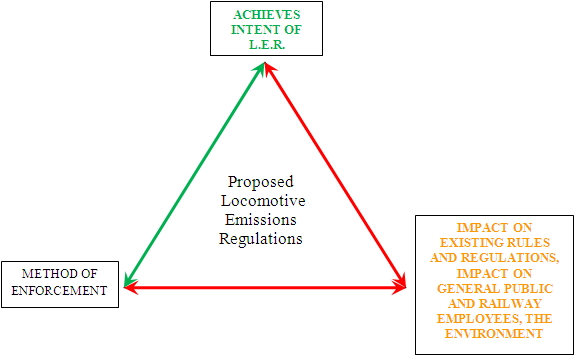
The TCRC / NLB have indentified three primary areas of the proposed regulations that raise concerns.
- The "method of enforcement" – the proposed regulations versus memoranda, railway general operating instructions to achieve reduced emissions
- Impact on the general public and railway employees.
- Impact on the environment.
There are many positive elements listed in the proposed locomotive emissions regulations, however they present some risks and concerns for the TCRC/NLB.
The TCRC/NLB will demonstrate within this brief for every attempt to reduce locomotive emissions, green house gases (as shown on the green line) we have identified some risks and concerns (as shown on the red lines).
Long Trains
Both Class "1" Canadian Carriers have introduced "Long trains" which have been used as a method to reduce locomotive emissions. Emission reduction is not the primary reasoning behind this method of train operation – rather reduced crew starts, increased corridor capacity, reduced fuel consumption are the primary goals, with lower emission being additional benefits.
Traditional train sizes of 6500 feet have been increased up to 14,000 feet.
The TCRC/NLB is in agreement that operation of longer trains does reduce the locomotive footprint, and achieves the goals of reducing fuel consumption and reduced emissions. To achieve maximum results ensure that horse power to tonnage ratio is within optimum range; this will lower operating throttle position in turn lowering emissions.
Risks Associated with Long Trains
"Method of Enforcement" – Is this practice to be embedded within the regulation to ensure long term emission reductions? The TCRC/NLB are concerned that the railway companies are going to be left to adopt and use this as a business practice and / or determine when economic conditions warrant. For example, should it become economically viable to run several short trains, as opposed to one long train, than any gains under the proposed locomotive emissions regulations will be lost.
The general railway infrastructure and accompanying operating rules were not designed with longer trains as part of their consideration. Previous urban planning did not take into consideration placement and use of level crossings at grade in conjunction with the operation of longer trains and their impact.
Consider CROR 103(d) "no part of a movement may be allowed to stand on any part of a public crossing at grade for a longer period than five (5) minutes" There is no limitation within the rules on a moving train – thus on a double track territory it is possible for two opposing 14,000 foot long trains to occupy a crossing for as much as 11.5 minutes while passing each other at 30 mph.
Should a long train of 14,000 feet be stopped in an emergency situation – its footprint while stopped will occupy over two and half miles which could include blocking several level crossings at grade. The issue of long trains needs to be fully examined to determine the actual impact as opposed to "risks" identified and addressed by risk assessment models.
Should the use of long train be a regulation as set out within the proposed "Canadian Locomotive Emissions Regulations", then it is the opinion of the TCRC / NLB that an updated environment impact study needs to be completed to address what effect current operations are having, along with long term impacts.
Smart Starts / Anti–Idling Provisions
Under the "1995 – 2005 Memorandum of Understanding", automatic stop/start systems were adopted into a proportion of the railway fleets including the three primary types of locomotives – "line haul locomotive, yard switcher locomotives and road switcher locomotives" and according to Transport Canada's web site2 there are approximately 3000 units in service between 2007/2008 . This contributed to the reported 3% reductions in emissions. No breakdown is provided as to how many of the current active locomotive fleet is equipped with an auto start system.
"Figure 4: Locomotive Duty Cycle by Service Type" 3 clearly shows for a life of a locomotive, the majority of a locomotive's duty cycle is spent at "idle". Thus the application of such a system is an important part of meeting the goals set out in the "Locomotive Emissions Regulations" and supported by the TCRC / NLB.
The TCRC/NLB has three concerns related to the use of auto stop/start systems.
- Proposed Anti–Idling Provision – this provision should be embedded in the regulation and / or left to railway company policy to enforce – should a violation be sited the appropriate regulatory body should issue appropriate direction.
- Application of auto stop/start systems – Experience by TCRC members has found that when applied to older locomotives, and in some cases newer locomotives, that the system nullifies the operation of such items as cab heaters, air conditioning, when equipped and on–board refrigerator operation.
- Develop guidelines within the regulations to ensure that in the application of auto stop/start systems that all safety appliances are protected. Example, on CN there are locomotives equipped with auto stop/start systems that does not ensure proper train line air brake pressure. This is an issue that needs to be addressed.
The TCRC / NLB is recommending that in the application of the "Anti–Idling Provision" locomotives must have an alternate system to supply heat, air conditioning, when equipped, working refrigerator.
Proposed Emission Testing Requirements
PowerPoint Slide 13 "Locomotive Emissions Regulations: Proposed Elements``, the responsibility for undertaking emission testing would be the responsibility of railway companies. The regulation should ensure that all companies who own and / or operate locomotives in Canada be held to Canadian emission testing standards. All testing should be conducted in Canada at CAD Railway Industries, NRE–ALCO Locomotive of Canada, Railpower Technologies Corp., or any other future facilities in Canada.
The TCRC / NLB reasons for this recommendation are set out below:
- The intent to ensure that all locomotives of all classes are sampled – not 10% of the whole fleet, but a % of each locomotive class, model type that is in service.
- The proposed locomotive emission regulations needs to ensure that for random testing or fleet percentage testing, that locomotives that have received prior emission testing and passed are not used in duplicate testing results for other units in the same locomotive class.
- Ensure that new "green" locomotives that use multiple prime movers, each prime mover must be covered under the proposed regulations and not the whole locomotive. http://www.greenrailnews.com/
- Ensure that all locomotives with US based maintenance shops and / or are assigned to US proportion of operations are included in sampling to ensure they are compliant should they be pressed into Canadian service.
- Ensure that locomotives that are leased from outside Canada and operated into Canada are held to the same Canadian regulations. There should be no exemption account leased from a foreign source, even though a leased locomotive may operate a limited amount of time in Canadian service. The proposed locomotive emissions regulations should provide for limited grandfathering clauses.
- A locomotive's class of service should have limited bearing for testing on green house gasses, a locomotive should be treated as either active or inactive. There are many examples where, what would be considered a line haul locomotive, upon reaching its final terminal is pressed into the role of a yard or road switcher locomotive. With modern railroading business practices the line between service class of a locomotive is largely blurred and of little meaning.
- Testing should be conducted at certified Canadian locations – to ensure that any of the Canadian regulatory body's inspectors have the ability to conduct on site audits and address compliance issues.
- Ensure that third party owner / operators, who do not fall under Federal jurisdiction, would enter into a memorandum of understanding (MOU) with Transport Canada or jurisdiction similar to the authority that the U.S. Environmental Protection Agency has4.
PowerPoint Slide17 of "Locomotive Emissions Regulations: Proposed Elements" appears to indicate that for "Compliance Life Cycle" a locomotive may only receive three tests during it's in service life.
- When a locomotive is placed into initial service.
- At the 50% mark of the useful life cycle.
- At the 75% mark of the useful life cycle.
Given the in–service life span of most railway locomotives, "has a life expectancy of 25 to 40 years or more"5, it is the opinion of the TCRC / NLB that the proposed regulations may not provide enough testing for an individual unit, since during the course of a unit's service life it may be branded under a number of accepted industry terms.6 A new locomotive could in fact be an upgraded locomotive, whose original manufacturing date was prior to January 01, 1973. Locomotive testing should be similar to the testing required by the some provinces in respect to automobiles – the province of New Brunswick for example requires a yearly mechanical inspection. This should not cause undue hardship to the railroad companies, as all locomotives are required to receive regular inspections for such items as the air brake system.
In addition, the proposed locomotive emissions regulations do not make any reference to locomotives equipped with secondary engines. Most commuter rail operators and some of VIA`s locomotive fleet have a secondary engine that provides what is generally referred to as hotel power and or Head End Power (H.E.P.).
- GO Transits new units MP40PH–C (600 series) have a primary engine rated at 4000hp – all directed at providing power for traction.
- H.E.P. provided by small Cummins / CAT / or other diesel manufactures.
Thus any emissions regulations need to ensure that secondary emission sources on a locomotive are covered.
Further emission testing methodology should consider testing while in actual service conditions in addition to static testing. Actual service testing would provide real time readings when combinations of units are used together in service. Mixed locomotive consist types are a common practice in the railroad industry, for which units that have passed emission testing on a solo bases, may not be in compliance when operating together.
Recently several media agencies reported in Chicago7 that the Northeast Illinois Regional Commuter Railroad Corporation / METRA commuter agency was dealing with reducing commuter exposure to diesel fumes.
The Chicago Tribune investigation reported that passengers were not only being exposed to higher levels of fumes while in covered stations, but "air quality gets worse yet after boarding a train, the testing found".8 The report goes on further to say "At a monthly board meeting, Richard Soukup, Metra's chief mechanical officer, quickly went through slides summarizing some of the test results. The highest average levels were found on trains leaving the cramped south platforms at Union Station, results that mirrored what the Tribune found during its testing.
On all Metra lines, average levels of pollution were substantially below any occupational standards, Soukup said. But some board members noted the figures he provided were averages for entire train runs and could mask spikes of diesel exhaust that commuters are exposed to at different points along their routes."
METRA provides service to over "80 million rides annually"9 on 11 different rail lines, using approximately 141 diesel–electric locomotives of which approximately 56 were built post 1991. To address this hazard METRA announced it will be switching to a cleaner fuel and installing more efficient air filters on its passenger's cars.
In light of these findings and similar station layouts at many locations in Canada, the proposed locomotive emissions regulations needs to address the types of filter systems on locomotive cabs and passenger equipment and / or the lack of any such equipment on current active fleets.
The regulations would also be weak if it did not address the railroad practice of "deadheading" 10 operating crews in other than the leading locomotive. This practice includes trailing locomotives in the consist, or DPU's11 placed throughout the length of the train.
Although there is a study conducted by Human Resources Development Canada entitled "Exposure to Diesel Exhaust Emissions and Noise on Board Locomotives – Report of Measurements Taken on Canadian Pacific Rail Equipment" published in 2001, the data contained in this report is approaching almost 10 years in age and may not reflect recent advances on the subject. Updated study(s) should be conducted.
Locomotive emission regulations cannot ignore the daily service operations that locomotives are placed in and the people who work and / or travel on the railroad.
PowerPoint Slide17 of "Locomotive Emissions Regulations: Proposed Elements", labelling requirements should include information on whether the unit can be occupied while in other than lead position for the purposes of deadheading.
Given the recent experience by METRA, additional labelling requirements may be warranted for a locomotive when it is operating under a covered structure (station platform), emissions level and exposure time limit.
Dynamic Brake Requirement
The TCRC/NLB supports the use of Dynamic Braking which is a train braking system that significantly reduces diesel emissions when locomotives are this mode of train braking.
At this time Dynamic Brake regulations only address Mountain Grade (1.8% or higher grade) or Heavy Grade (0.8% to 1.8%) that require all equipped locomotives that have dynamic brake feature to be in working order.
The TCRC/NLB recommends that all locomotives that are equipped with dynamic braking, have working Dynamic Brake feature operative. This will help reduce Green House Gasses as outlined in Annex A page 28 of the Rolling Towards a Cleaner Future Brief. The TCRC/NLB requests that this be considered in the regulation.
Conclusions
The effort to regulate locomotive emissions should be embedded in regulations as opposed to memoranda, railway general operating rules or "best practices". Experience has taught that elements that are not embedded in firm regulations, can be eroded over time by the impact of business plans, risk assessments etc. By its nature memoranda, railway general operating rules or "best practices" will more easily be subject to economic pressures. Considerations should be made to ensure that those who will be directly affected by the proposed regulations are not over looked; the general public who travel by train, who live near railroad right of ways and operations and the railway workers who will be directly affected by the proposed locomotive emission regulations.
1 Par four executive summary iii issue brief "rolling towards a cleaner future / Transport Canada
2 http://www.tc.gc.ca/eng/programs/environment-ecofreight-about-voluntary-voluntaryagreementsrail-1845.htm
3 Rolling towards a Cleaner Future – The Development of Canadian Locomotive Emissions Regulations Issue Brief pg 28
4 pg 17 – top par. "Rolling Towards a Cleaner Future: The Development of Canadian Locomotive Emission Regulations / issue Brief December 2010"
5 Pg 5 "Rolling Towards a Cleaner Future: The Development of Canadian Locomotive Emission Regulations Issue Brief" December 2010
6 Slide 3 & 4 PowerPoint Locomotive Emissions Regulations: Proposed Elements December 2010
7 http://www.wgnradio.com/news/ct-met-metra-diesel-pollution-20110114,0,1860381.story
8 http://www.wgnradio.com/news/ct-met-metra-diesel-pollution-20110114,0,1860381.story
9 As reported on Wikipedia – http://en.wikipedia.org/wiki/Metra
10 Deadheading refers to repositioning operating train crews from one location/terminal to another in non working service.
11 DPU = Distributed Power Units refers to operating practice of positioning a number of locomotives through the length of the train controlled by a single engineer in the lead unit.