
A tire fire on a truck transporting explosives can result in a detonation!
Transport Canada (TC) is always on the lookout for the challenges faced by dangerous goods carriers and emergency personnel. This document provides first responders, police services, and industry with information and tools pertinent to the measures to be taken in the event of an incident involving a tire fire on a truck transporting dangerous goods from Class 1 – Explosives. It is important to note that this document also applies to Ammonium Nitrate Emulsion, which can be shipped as UN3375 (Class 5.1) or UN0332 (Class 1.5D).
The Government of Western Australia has produced an informative video demonstrating the risks and consequences of incidents involving a tire fire on trucks transporting explosives. These situations are rare, but the risk of detonation is real and must be taken very seriously.
Source: Department of Local Government, Industry Regulation and Safety, Government of Western Australia
Transcript
The Department of Mines, Industry Regulation and Safety would like to acknowledge the Yilka Talintji people, past and present, who occupy the land where this incident occurred.
On Sunday the 23rd of October 2022, a road train was filled with ammonium nitrate emulsion at Kwinana.
After filling, it then departed for Gruyere mine site. The driver rested overnight near Leonora, approximately 300 kilometres from the incident scene.
After completing his pre-start checks on the morning of the 24th of October, the driver continued the journey to Gruyere mine site.
The driver was travelling on a gravel road, when at approximately 9:00am he joined two other trucks near Cosmo Newberry, a remote Aboriginal community.
At 9:30am the driver notices black smoke coming from the rear wheels of the rear tanker.
He notifies the other vehicles in the convoy by two-way radio.
It is thought that the tire fire was initiated from a leaking air supply line, causing brakes to lock on and overheat.
The driver pulls over the vehicle and attempts to extinguish the tire fire.
At one point he lies on his back to get better access to extinguish the flames.
Soon after, the airbag suspension bursts on the truck, causing it to drop in height, at which point the flames are now approximately 45 centimetres above the mudguards.
The driver radios the two other trucks nearby explaining that he is going to leave the scene.
The other vehicles notify emergency services of the situation.
The driver disconnects the rear tanker trailer. He observes the smoke is thick and black.
At approximately 9:50am the driver leaves the scene and sets up a barricade on the
eastern side, blocking traffic at the turn off to the mine site.
At this stage a hole is beginning to form in the shell of the aluminium tanker trailer.
At 10:05am the driver observes white smoke coming from the fire.
The ammonium nitrate emulsion flows onto the ground.
It becomes constrained by the topography of the road and pools beneath the tanker trailer.
It is affected by the fire and starts to decompose, producing white smoke.
The mine emergency response team arrives at 10:50am.
At approximately 11:05am the emergency response team enters the barricaded area to within 1.3 kilometers of the fire.
They warn and escort out a motorcycle and a car that enter the area from the western side.
While within the barricaded area, the emergency response team observes the tires at the front of the tanker trailer are alight and flames are engulfing it from the ground.
The smoke plume is approximately 20 metres high, and the colour is changing from black to white.
At 11:33am there is an explosion.
The Emergency Response Team sees this and capture photos.
The smoke plume is estimated to be 1 kilometre in height.
Following the explosion, the scene was examined by first responders and then Department investigators.
The tanker trailer was completely destroyed.
A crater was formed in the road as a result of the blast. It was large and shallow, with the deepest point being approximately 1.1 metre deep.
The fire melted a hole in the aluminium tanker, causing the Ammonium nitrate emulsion to flow onto the ground. The fire decomposed the ANE, and burnt the fuel component of the emulsion.
It was molten sensitized ammonium nitrate which then exploded.
The size of the blast is estimated to be 1 to 3 tonnes of TNT equivalent.
At 50 metres from the epicentre of the explosion, 7 metres high trees were snapped at ground level.
Aluminium and steel shrapnel was found scattered predominantly to the southeast of the road, indicating the explosion occurred towards the rear of the tanker trailer.
Following the investigation, a number of recommendations were developed to improve the safe transport of ammonium nitrate emulsion and similar products.
These include control measures to prevent and mitigate tire fires, which may lead to an explosion.
For a copy of the investigation report, please visit the Department’s website and search ANE Tanker Explosion.
How to prepare if this occurs in your community
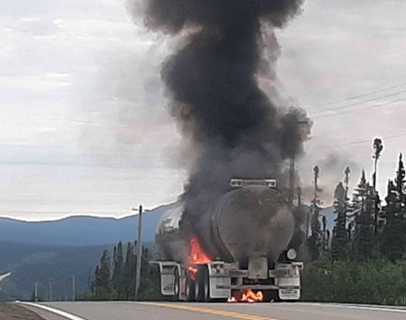
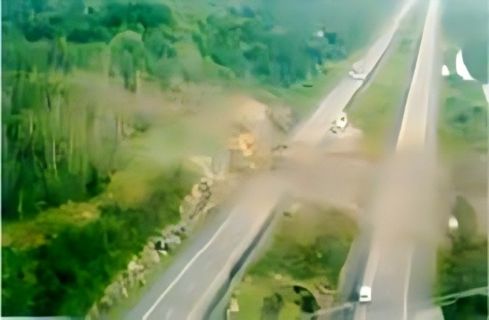
A tire fire like the one seen on the image on the left, where the means of containment is flame impinged, could lead to a detonation such as the image shown on the right. In the image on the right, a truck carrying explosives detonated in Walden, ON, Canada (1998), resulting in the destruction of the truck, the highway, and a nearby rock wall.
Planning
Determine whether explosives are shipped through your community, and prepare for emergencies, such as practicing evacuations/sheltering for 1600 metres and preparing your community for such events.
Tool: use the Aide-mémoire for first responders to become familiar with the steps to follow in case of an incident involving explosives: know, practice, use, be prepared!
Considerations
| Consideration | Description |
|---|---|
| Materials | Flammable materials such as cargo walls made of fabric material can be a source of fuel during a fire. |
| Amount | Quantity transported: small or residue versus full cargo or full load. |
| Energy | Energy isolation is of primary importance (fuel source, ignition source). Explosives are high energy materials that may detonate with an ignition. |
| Reaction time | Reaction time and actions are critical. Detonation can occur imminently or within a few hours. Consider or implement evacuation or shelter in place. |
| Distance | Immediate precautionary measure: 800 metres minimum in all directions, or 1600 metres in case of fire. |
| Water | Evaluate the accessibility to water sources: water tender, hydrant, pond, river, etc. if the tire fire can be extinguished before it impacts the explosive cargo. |
Response
The guide below outlines primary actions for truck drivers, fire and police services in case of an incident during the transport of explosives.
Tool: Explosives and Oxidizers by Road: Tire Fire Awareness and Response

Request a copy of Explosives and Oxidizers by Road: Tire Fire Awareness and Response by email
Inappropriate responses or delays in implementing response actions can result in mass detonation events causing serious injury or death.
Access to expertise
Call CANUTEC and get assistance from a TC Remedial Measures Specialist (RMS) or obtain assistance from the shipper and the Emergency Response Assistance Plan (ERAP) holder. The ERAP telephone number is on the bill of lading.
CANUTEC can provide information and assistance during any step of an incident. Dial 613-996-6666, 1-888-CAN-UTEC (226-8832) or *666 from a cell phone (in Canada).