
On this page
- Transport Canada’s TDG program
- Dangerous goods classes
- CANUTEC
- Emergency Response Guidebook (ERG)
- Shipping document
- Emergency Response Assistance Plan (ERAP)
- Reporting a dangerous goods incident
- Remedial Measures Specialist (RMS)
- Incident Command System (ICS)
- Protective Direction (PD)
- Additional resource: AskRail®
- Best practices
- You’re not alone!
- Transport Canada contact information
Transport Canada’s TDG program
- Transport Canada’s TDG program develops and implements the national program to promote public safety during the transportation of dangerous goods
- Dangerous goods are products, substances or organisms, which can be solids, liquids or gases, that can harm people, other living organisms, property or the environment if released in the course of transportation
- Dangerous goods are regulated for transport and are transported in means of containment that are required and permitted under the Transportation of Dangerous Goods Regulations (TDG Regulations)
Dangerous goods classes
Dangerous goods are sorted into nine classes and are transported with labels or placards indicating their class. For more information, consult Dangerous goods marks and classes description.
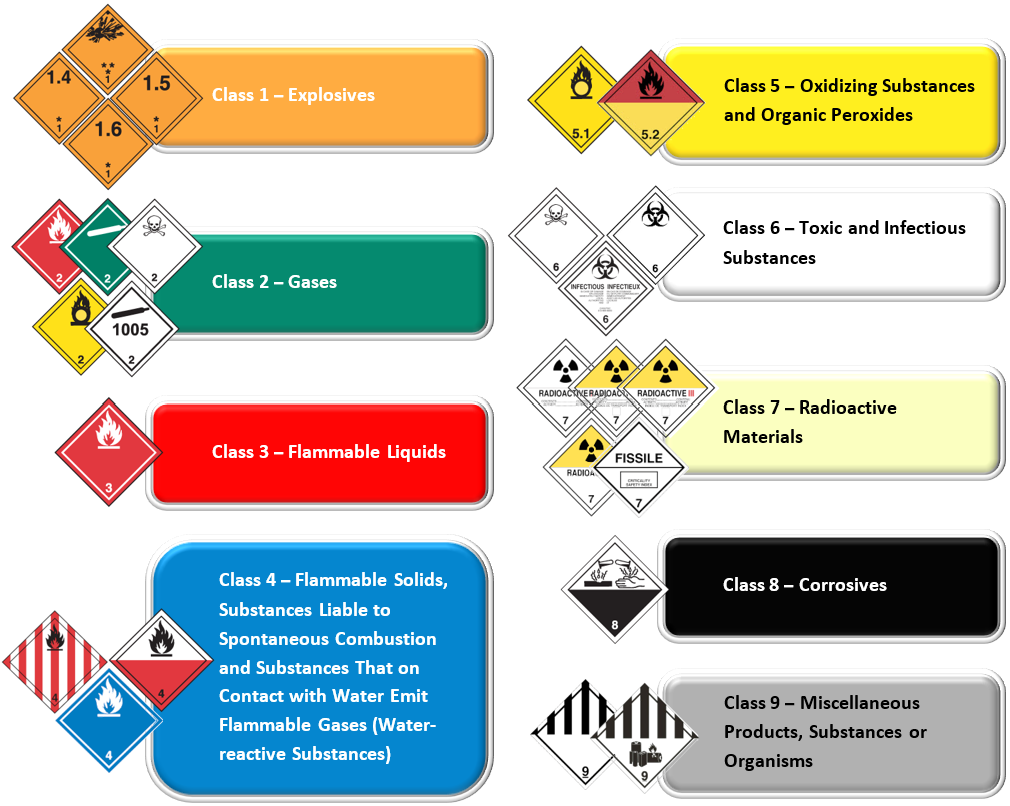
Dangerous goods classes - Text version
| Class | Class name | Placard(s) description |
|---|---|---|
| Class 1 | Explosives |
Top image: Placard and label for Class 1.1, 1.2 and 1.3. Square on a point. Orange background. Starting from the bottom, the number 1, above it, * (asterisk) which corresponds to the Compatibility Group Letter and ** (double asterisk) for Division. Symbol of an exploding bomb in top portion. Left middle image: Placard and label for Class 1.4. Square on a point. Orange background. Starting from the bottom, the number 1, above it, * (asterisk) which corresponds to the Compatibility Group Letter. Number 1.4 in top portion. Right middle image: Placard and label for Class 1.5. Square on a point. Orange background. Starting from the bottom, the number 1, above it, * (asterisk) which corresponds to the Compatibility Group Letter. Number 1.5 in top portion. Bottom image: Placard and label for Class 1.6. Square on a point. Orange background. Starting from the bottom, the number 1, above it, * (asterisk) which corresponds to the Compatibility Group Letter. Number 1.6 in top portion. |
| Class 2 | Gases |
Top left image: Placard and label for Class 2.1. Square on a point. Red background. Starting from the bottom, the number 2. Symbol of a flame in white in top portion. Top middle image: Placard and label for Class 2.2. Square on a point. Green background. Starting from the bottom, the number 2. Symbol of a gas cylinder in white in top portion. Top right image: Placard and label for Class 2.3. Square on a point. White background. Starting from the bottom, the number 2. Symbol of a skull and crossbones in top portion. Bottom left image: Placard and label for Oxidizing Gases. Square on a point. Yellow background. Starting from the bottom, the number 2. Symbol of a flame over a circle (flaming "O") in black in top portion. Bottom right image: Placard for UN1005, Anhydrous Ammonia. Square on a point. White background. Starting from the bottom, the number 2, above it, the number 1005. Symbol of a gas cylinder in black in top portion. |
| Class 3 | Flammable Liquids | Placard and label for Class 3. Square on a point. Red background. Starting from the bottom, the number 3. Symbol of a flame in white in top portion. |
| Class 4 | Flammable Solids, Substances Liable to Spontaneous Combustion and Substances That on Contact with Water Emit Flammable Gases (Water-reactive Substances) |
Top left image: Placard and label for Class 4.1. Square on a point. White background with 7 red stripes. Starting from the bottom, the number 4. Symbol of a flame in black in top portion. Top right image: Placard and label for Class 4.2. Square on a point. Upper half of background is white and lower half is red. Starting from the bottom, the number 4. Symbol of a flame in black in top portion. Bottom image: Placard and label for Class 4.3. Square on a point. Blue background. Starting from the bottom, the number 4. Symbol of a flame in white in top portion. |
| Class 5 | Oxidizing Substances and Organic Peroxides |
Left image: Placard and label for Class 5.1. Square on a point. Yellow background. Starting from the bottom, the number 5.1. Symbol of a flame over a circle (flaming "O") in black in top portion. Right image: Placard and label for Class 5.2. Square on a point. Upper half of background is red and lower half is yellow. Starting from the bottom, the number 5.2. Symbol of a flame in black in top portion. |
| Class 6 | Toxic and Infectious Substances |
Top left image: Placard and label for Class 6.1. Square on a point. White background. Starting from the bottom, the number 6. Symbol of a skull and crossbones in top portion. Top right image: Placard for Class 6.2. Square on a point. White background. Starting from the bottom, the number 6. Symbol of three crescents superimposed on a circle in top portion. Bottom image: Label for Class 6.2. Square on a point. White background. Starting from the bottom, the number 6, and above it, the following text: INFECTIOUS...IN CASE OF DAMAGE...OR LEAKAGE...IMMEDIATELY...NOTIFY...LOCAL AUTHORITIES...AND...CANUTEC...613-996-6666 (identical text in French). Symbol of three crescents superimposed on a circle in top portion. |
| Class 7 | Radioactive Materials |
Top left image: Label for Class 7, Category I. Square on a point. White background. Starting from the bottom, the number 7, above this, the following text: ACTIVITY...CONTENTS (identical text in French). Above this, the word RADIOACTIVE followed by one vertical bar in red below the middle line. Symbol of a trefoil in top portion. Top middle image: Label for Class 7, Category II. Square on a point. Upper half of background (excluding border) is yellow and lower half and border is white. Starting from the bottom, the number 7, above this, a box, then the following text: TRANSPORT INDEX...ACTIVITY...CONTENTS (identical text in French). Above this, the word RADIOACTIVE followed by two vertical bars in red below the middle line. Symbol of a trefoil in top portion. Top right image: Label for Class 7, Category III. Square on a point. Upper half of background (excluding border) is yellow and lower half and border is white. Starting from the bottom, the number 7, above this, a box, then the following text: TRANSPORT INDEX...ACTIVITY...CONTENTS (identical text in French). Above this, the word RADIOACTIVE followed by three vertical bars in red below the middle line. Symbol of a trefoil in top portion. Bottom left image: Placard for Class 7. Square on a point. Upper half of background (excluding border) is yellow and lower half and border is white. Starting from the bottom, the number 7, above this, the word RADIOACTIVE below the middle line. Symbol of a trefoil in top portion. Bottom right image: Label for Class 7, Fissile. Square on a point. White background. Starting from the bottom, the number 7, above this, the following text in a box: CRITICALITY SAFETY INDEX. Above this, the word FISSILE. |
| Class 8 | Corrosives | Placard and label for Class 8. Square on a point. Upper half of background and border is white and lower half is black. Starting from the bottom, the number 8. Symbol of liquid spilling from two test tubes and attacking a hand and a metal bar in top portion. |
| Class 9 | Miscellaneous Products, Substances or Organisms and Lithium Batteries |
Left image: Placard and label for Class 9. Square on a point. White background with 7 black stripes in upper half. Starting from the bottom, the number 9. Right image: Label for Class 9 for lithium batteries. Square on a point. White background with 7 black stripes in upper half; battery group, one broken and emitting flame in lower half. Starting from the bottom, the number 9. |
CANUTEC
- CANUTEC is the Canadian Transport Emergency Centre operated by Transport Canada
- CANUTEC’s mission is to promote public safety by providing chemical emergency response advice and to support preparedness and response in the transportation of dangerous goods
- CANUTEC’s role is to provide advice during a dangerous goods incident but also to bring together all the players involved in the incident
- Bilingual scientists work at CANUTEC on a 24/7 basis, are trained in emergency response and are ready to assist during a dangerous goods incident
- When first responders arrive at the site of a dangerous goods incident, they should also contact CANUTEC for assistance
CANUTEC is the TDG emergency call center providing technical advice and emergency response services to first responders at an incident, 24/7, such as:
- chemical, physical and toxicological properties of dangerous goods
- possible product incompatibilities and stabilities
- health hazards and first aid measures
- fire, explosion, spill or leak mitigation techniques
- remedial actions for the protection of life, property and the environment
- isolation and evacuation distances
- donning of personal protective equipment and their decontamination procedures
- coordination of communications with consignor, government and medical specialists
- quick access to a vast national and international resource network which includes the industrial sector, emergency response teams, private response contractors, mutual aid groups, federal and provincial response specialists and other emergency centres
- participation with fire departments, public authorities and industry during their training exercises
Emergency Response Guidebook (ERG)
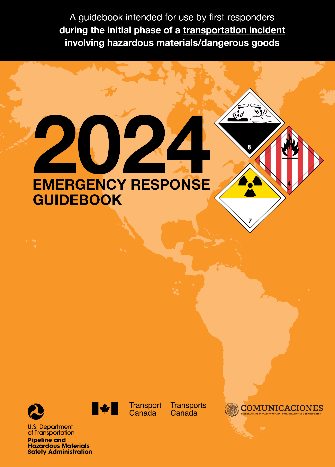
When first responders arrive at the site of a dangerous goods incident, they should refer to the ERG to determine safe distances and secure the scene.
The ERG is developed by Transport Canada (CANUTEC), the United States, Mexico and Argentina. The guide also provides first responders with:
- quick identification of the hazards of the materials involved in the dangerous goods incident
- information on how to protect themselves and the general public
For more information on the ERG, consult the Emergency Response Guidebook - 2024.
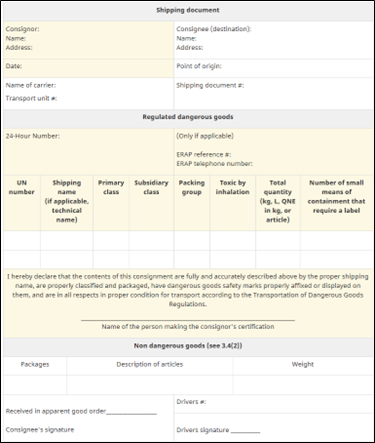
Shipping document
In addition to observations of the scene from a safe distance, if it can be safely retrieved, the shipping document is an important piece of information. It may be in the form of a paper or an electronic copy and it will include the following information:
- shipping name of the dangerous goods and their classification
- amount of dangerous goods being transported
- 24-Hour Number for technical information about the dangerous goods
- ERAP telephone number (if applicable) for technical and/or emergency response advice
For more information on shipping documents, consult Part 3 – Documentation of the TDG Regulations and the Shipping document.
Emergency Response Assistance Plan (ERAP)
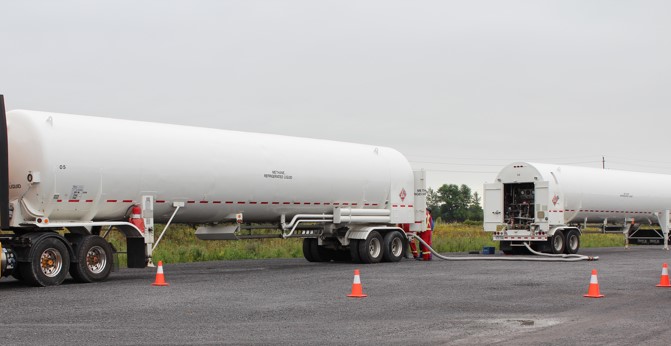
- An ERAP describes what to do in the event of a release or anticipated release of dangerous goods while in transport
- Only certain high-risk dangerous goods in specified quantities, means of containment or modes of transport need an ERAP
- It describes the specialized response capabilities, equipment and procedures that will be used to support a response to incidents involving dangerous goods
Person who requires an ERAP
- Persons who have ERAPs are involved in the transportation of certain dangerous goods above the quantity specified in the TDG Regulations
- They are often producers, manufacturers or distributors of dangerous goods
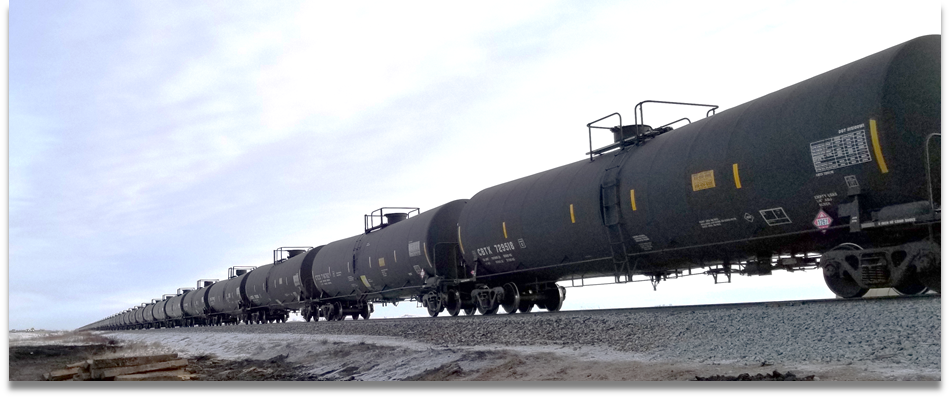
Purpose of an ERAP
- A person with an approved ERAP uses the plan to assist emergency responders
- ERAPs may be used along with Emergency Response Plans (ERP) from other organizations (carriers, municipalities, communities and local or provincial authorities)
- An Incident Command System (ICS) ensures coordination between the ERAP and other emergency response plans, in order to:
- ensure public safety
- ensure that specialized assistance is available to local responders
- minimize consequences

Components of an ERAP
- ERAPs are approved by Transport Canada following the conditions indicated in Part 7 – Emergency Response Assistance Plan of the TDG Regulations
- An ERAP addresses emergency preparedness, including personnel training, response exercises and equipment maintenance
- Each plan is specific to certain:
- dangerous goods
- modes of transport (air, rail, road, marine)
- means of containment (containers or packaging)
- geographical areas in which the dangerous goods will be transported
ERAP implementation
- ERAPs are implemented to respond to a release or anticipated release of the dangerous goods that are part of the plan
- The person who has the ERAP is contacted through the ERAP telephone number. Once reached, this person determines the actions they will take to respond to the release or anticipated release
- Every ERAP must have an ERAP telephone number, where assistance should be provided as soon as possible after the initial request, 24/7
- When an ERAP is required, this number is found on the shipping document
- Persons calling the ERAP telephone number will be connected with someone who can:
- provide technical and/or emergency response advice promptly
- monitor the response
- send emergency response resources, if required
- Anyone can call the ERAP telephone number for assistance
- Only the persons who have the ERAP are responsible for implementing it. Any other person or organization cannot implement an ERAP
- When necessary to protect public safety, section 7.1 of the Transportation of Dangerous Goods Act (TDG Act) allows Transport Canada to:
- direct a person with an approved ERAP to implement their plan in order to respond to a release or anticipated release
- authorize a person with an approved ERAP to implement their plan, if it is unclear who is required to have an ERAP for the dangerous goods involved in an incident
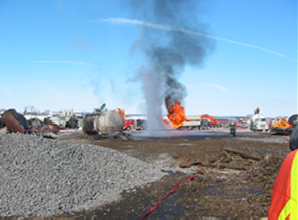
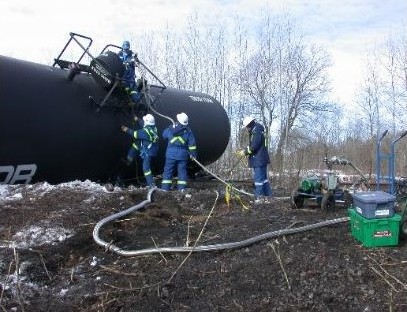
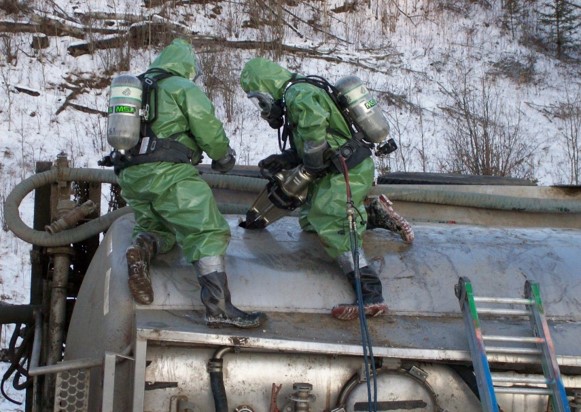
Expectations with an approved ERAP
- Over the phone:
- technical or emergency response advice
- assistance provided as soon as possible after the initial request
- On siteFootnote *:
- response personnel with appropriate equipment
- assistance provided may vary based on the nature, the severity of the incident or the assistance required
Reporting a dangerous goods incident
When a release or anticipated release of dangerous goods during transportation occurs, any person who has the charge, management or control of a means of containment shall call:
- appropriate local authority (9-1-1)
- CANUTEC at1-888-CAN-UTEC (226-8832), 613-996-6666 or *666 on a cellular phone (in Canada only)
If the shipment requires an ERAP, a call also must be made to the ERAP holder via the ERAP Telephone Number located on the shipping document.
Part 8 – Reporting Requirements of the TDG Regulations specifies the requirements when a release or anticipated release occurs.
For more information, consult the Guide for reporting dangerous goods incidents.
Remedial Measures Specialist (RMS)
- A designated TDG inspector under the TDG Act
- A scientist trained and specialized in emergency response
- An ERAP specialist who can attend the site of an incident involving dangerous goods
Role of the RMS
- Review ERAP applications and evaluate if the plan can be implemented and will be effective at responding to an actual or anticipated release of dangerous goods that endangers or could endanger public safety
- Conduct oversight activities such as site assessments and exercise attendance to confirm the response capabilities identified in the ERAP
- Promote awareness of the ERAP program by participating in and presenting at various events across the country

Role of the RMS at a dangerous goods incident site
- Monitor the implementation of an ERAP to ensure its effectiveness – timely, appropriate, safe and coordinated (TASC)
- Provide advice on response capabilities, remedial measures, safe practices and chemical-specific knowledge to the Incident Commander (IC)
- Monitor and assess industry’s response (carriers, consignors/shippers, person with an approved ERAP or emergency response contractors)
- Direct or stop actions, if required, to protect public safety and personnel on site
- Communicate relevant incident information to Transport Canada through CANUTEC
Incident Command System (ICS)
The Incident Command System (ICS) is a standardized approach for managing all types of emergencies.
ICS
- Provides a clear organizational structure for personnel, equipment, and communications
- Promotes a collaborative work environment by uniting all responding agencies under one command structure
- Adapts to the size of an incident, so it can be scaled up or down and still be effective
- Uses standardized terminology in clear and concise language ensuring all responders understand and follow the same protocols
Incident Commander
The Incident Commander (IC) is the person in charge at the incident site and is appointed by the Authority Having Jurisdiction (AHJ).
The Incident Commander is responsible for:
- establishing command
- ensuring responder safety
- assessing incident priorities
- determining operational objectives
- developing and implementing an incident action plan
- developing an organizational structure
- managing incident resources
- coordinating the activities of outside agencies
As incidents can involve many different participating agencies, having an ICS in place will help first responders to deliver a coordinated response to complex and/or large-scale incidents by:
- recognizing one Incident Commander (IC) assigned by the Authority Having Jurisdiction (AHJ)
- operating in a unified command structure
- clearly understanding respective roles and responsibilities
- prioritizing public safety over enforcement operations until such time as public safety is secure
- planning and exercising working in ICS, which helps build trust and improve networking ahead of a crisis
Protective Direction (PD)
A Protective Direction (PD) is issued under Section 32(1) of the TDG Act to cease an activity or to conduct other activities to reduce any danger to public safety.
PD 36
- Directs any company who transports dangerous goods through a jurisdiction (municipality) by rail, to provide the municipality’s Emergency Planning Official (EPO) with information on the nature and volume of dangerous goods it transports through the municipality
- Directs Canadian Class I Rail Carriers to publish an annual report containing dangerous goods information on their website
- Requires railway companies to provide in writing to CANUTEC, contact information of the person who will liaise with a municipality’s EPO
Benefits for municipalities
- Raise awareness on the dangerous goods being transported by rail within their boundaries
- Helps municipalities plan and prepare their Emergency Response Plan (ERP) accordingly
Transport Canada strongly encourages each municipal EPO to register with CANUTEC in order to receive information on the nature and volume of dangerous goods being transported by rail through their municipality.
Additional resource: AskRail®
The AskRail® app is a safety tool that gives first responders immediate access to accurate, timely data about railcar contents so they can make informed decisions in the event of a rail emergency.
- Use a railcar ID search to see whether a railcar on a train is carrying dangerous goods
- View the contents of the entire train
- View emergency contact information for all Class I railroads (CN & CPKC) and available shortlines
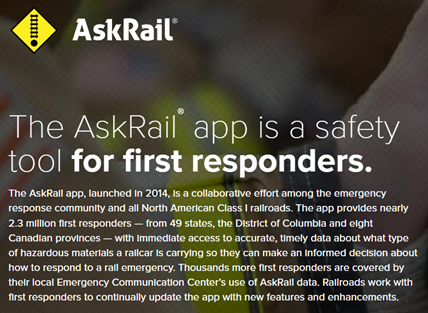
AskRail® infographic - Text version
AskRail logo with the following text:
The AskRail® app is a safety tool for first responders.
The AskRail app, launched in 2014, is a collaborative effort among the emergency response community and all North American Class I railroads. The app provides nearly 2.3 million first responders — from 49 states, the District of Columbia and eight Canadian provinces — with immediate access to accurate, timely data about what type of hazardous materials a railcar is carrying so they can make an informed decision about how to respond to a rail emergency. Thousands more first responders are covered by their local Emergency Communication Center’s use of AskRail data. Railroads work with first responders to continually update the app with new features and enhancements.
Key points
- Is a collaborative effort among all North American Class I railroads, the Association of American Railroads, Railinc Corp. and the Transportation Technology Center, Inc.
- All North American Class I railroads are using the app
- Provides single-car information on participating regional railroads
- Map feature provides isolation zone and points of interest such as railroad milepost and grade crossing locations
- Available in English and French in the U.S., Canada and Mexico
Request the application
For security reasons, only qualified emergency responders who have completed rail emergency training sponsored by one of the Class I railroads or at the Security and Emergency Response Training Center (SERTC) can download and use the AskRail® app. In addition, railroads can offer the app to known emergency responders along their routes.
Visit their website: AskRail®
Railway Association of Canada (RAC): AskRail™ | Railway Association of Canada

Best practices
To better prepare for dangerous goods incidents in transport, municipalities should:
- review their Emergency Response Plan (ERP) template to include response to dangerous goods incidents
- take advantage of PD 36 during the preparation of their ERP to receive information on dangerous goods transported by rail
- identify industries in their cities and dangerous goods transiting through them
- Provide Transport Canada Aide-Memoires to their first responders
- Identify the dangerous goods their first responders are trained and equipped to respond to and those dangerous goods to which they would require assistance
- test their ERP by organizing training and exercises, including participants from other organizations to evaluate interoperability
- register for the online TDG Newsletter for valuable information on the transportation of dangerous goods
You’re not alone!
Emergency response planning for rail incidents involving flammable liquids
- Assist local communities to plan and prepare for potential rail incidents involving flammable liquids
- Designed to be used as a template that can be tailored to address identified hazards as they pertain to flammable liquids being transported by rail through or near the community as a component of a local emergency response plan
- Offer tools for police, rescue, medical and firefighting operations to combat the effects of a major rail incident occurring within a community
You’re Not Alone! - Emergency Response Planning For Rail Incidents Involving Flammable Liquids

Practical tools for planning and responding to dangerous goods incidents
- Aide-mémoire: 15 classes and divisions of dangerous goods
- Dangerous goods incident worksheet: To take notes when using the Aide-mémoire, step by step
- Dangerous goods incident pre-plan worksheet
You’re not alone! – Practical tools for planning and responding to dangerous goods incidents

You’re not alone! – Aide-mémoire
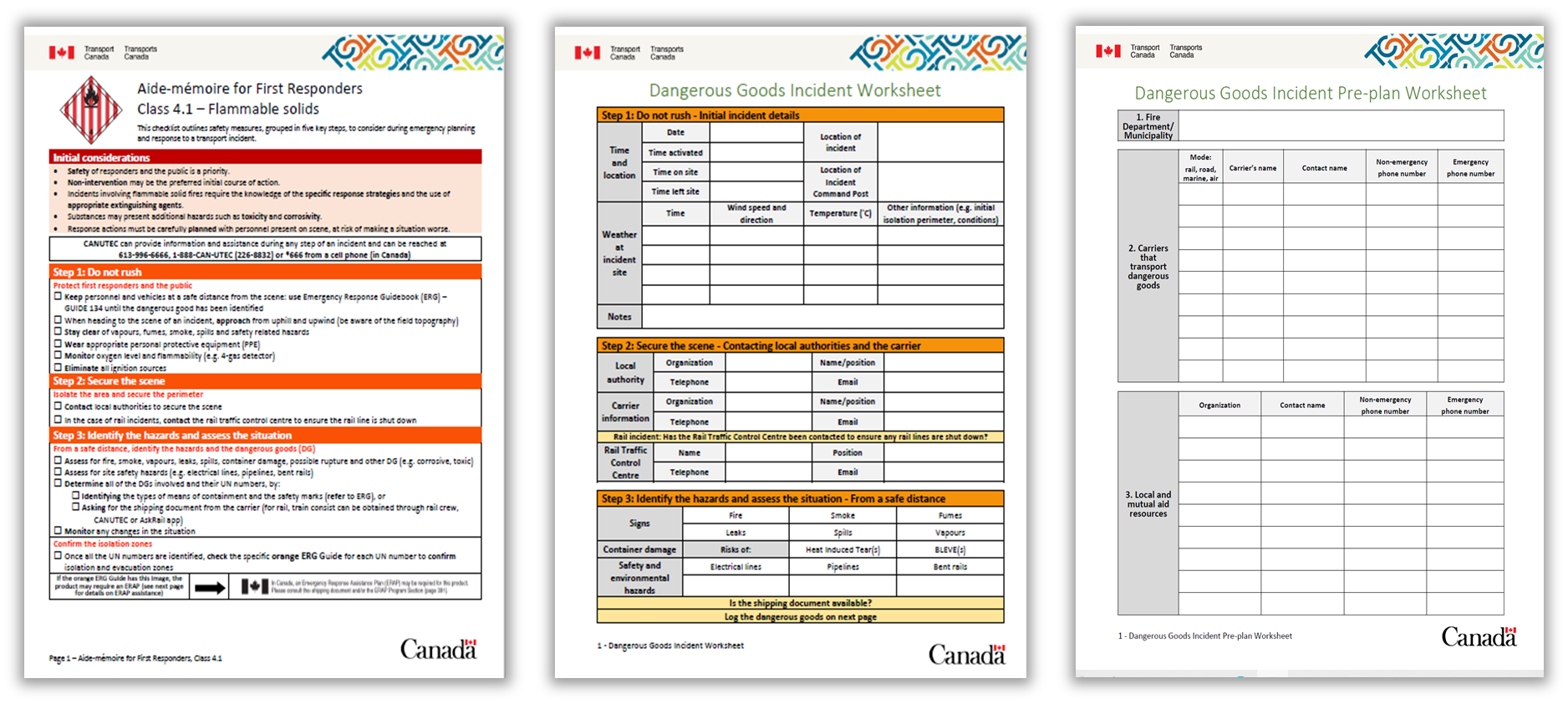
You’re not alone! – Aide-mémoire
Transport Canada contact information
CANUTEC
For emergencies (24/7) dial:
- 1 888 CAN-UTEC (226-8832)
- (613) 996-6666 or
- *666 on a cellular phone (in Canada only)
Website: CANUTEC
General TDG regulatory questions
Response Operations (ERAP Program)
TC.ChiefResponseOperations-ChefOperationsDeReponse.TC@tc.gc.ca
TDG marine
TC.TDGMarineInquiries-DemandesDeRenseignementsMaritimeTMD.TC@tc.gc.ca
TDG aviation
TC.TDGAviationInquiries-DemandesDeRenseignementsAviationTMD.TC@tc.gc.ca
TDG road and rail
| Region | Telephone number | Email address |
|---|---|---|
| Atlantic | 1-866-814-1477 | TDG-TMDAtlantic@tc.gc.ca |
| Quebec | 1-514-633-3400 | TMD-TDG.Quebec@tc.gc.ca |
| Ontario | 1-416-973-1868 | TDG-TMDOntario@tc.gc.ca |
| Prairie & Northern | 1-888-463-0521 | PNRTDG-TMDRPN@tc.gc.ca |
| Pacific | 1-604-666-2955 | TDGPacific-TMDPacifique@tc.gc.ca |
If you wish to have an awareness presentation on these topics, contact the TDG Safety Awareness Team: TC.TDGSafetyAwareness-SensibilisationalasecuriteduTMD.TC@tc.gc.ca.
