
Copyright
© His Majesty the King in Right of Canada, as represented by the Minister of Transport, 2025.
Permission is granted, by Transport Canada, to copy this TP 15697E as required. While use of this material has been authorized, Transport Canada shall not be responsible for the manner in which the information is presented, nor for any interpretations thereof. This TP 15697E may not be updated to reflect amendments made to the original content. For up-to-date information, contact Transport Canada.
ISBN: 978-0-660-97888-8
Catalogue No.: T29-191/2026E-PDF
On this page
1.0 General
1.1 Purpose
This document explains the regulatory requirements and best practices for providing a safe way to access any vessel moored at quay side. It covers the requirements for gangways, accommodation ladders, and installing safety nets.
This document doesn’t cover access to passenger vessels.
1.2 Scope
The guidance in this document is intended for:
- all Canadian vessels
- all foreign vessels in Canadian waters
- all stevedoring companies, and
- all port terminals
1.3 Terms
Accommodation Ladder: A type of ladder attached to a platform that stays fixed to the side of a vessel. The ladder can be moved using equipment on the vessel to help people get on or off the vessel from the shore (dock).
Gangway: A narrow, movable platform used to help people safely move between a docked vessel and the shore (quay), or between two vessels.
Means of access: The tools and steps used to help people move safely between a vessel and the shore, or from one vessel to another.
Qualified person: A person who has the right knowledge, training, and experience to safely do a specific task.
Recognized organizations: These include groups that give certifications, groups of professional engineers, classification societies (Flag State), or the Protection and Indemnity Clubs (P&I Clubs).
Type A Gangway: A gangway with a flat platform and crosswise non-slip bars. It can tilt up to 30° from flat ground (Source ISO standard 7061).
Type B Gangway: A gangway with curved, non-slip steps and rails that support the weight. It has a protective layer underneath and can tilt up to 55° from flat ground (Source ISO standard 7061).
1.4 Background
During recent inspections, Transport Canada inspectors have noted many issues with how access equipment has been installed. Such as, excessive angles, inadequate guardrails, unsafe attachments, the use of problematic combinations composed of gangways and ladders, maintenance deficiencies, and inappropriately installed safety nets, rendering them useless.
In order for people to safely board and disembark, the means of access and safety nets must comply with the requirements listed in Section 1.6 of this document. The goal is to protect people from falling, drowning, or being crushed between a dock and a vessel. Not understanding or knowing how to use the regulations can lead to injuries or even death.
1.5 Framework
In order to give people a safe means of access you should:
- comply with regulations and standards. All means of access and safety nets must comply with the regulations listed in Section 1.6 to prevent falls, drowning, or being crushed between the dock and the vessel
- assess the risks.Perform regular risk assessments to identify potential hazards and ways to manage them. This includes evaluating the position, angle of use, and stability of access equipment
- inspect equipment regularly. Do thorough and regular inspections of all access equipment, including gangways, ladders, and safety nets. Look for signs of wear, damage, or improper installation
- train personnel. Train all personnel involved in installing, using, and maintaining access equipment. Make sure they’re aware of the potential risks and how to manage them
- keep good records. Keep detailed log of inspections, maintenance, and any incidents. These documents can help identify recurring issues and improve safety protocols
1.6 Acts and regulations
This section outlines key rules from Canada’s regulations about safe access to vessels. If there’s a conflict between two sets of rules, you must follow the stricter rule.
Canada is aligning our marine safety rules with standards from the International Maritime Organization. This is helping us improve safety, protect the environment and make operations more efficient.
Authorized representatives of vessels and employers must understand that they need to work together to make sure that access to, and from, vessels is secure and reliable.
1.6.1 Canada Labour Code
Under paragraph 125(1)(b) of part II of the Canada Labour Code employers must “install guards, guard-rails, barricades, and fences” that meet safety standards.
Paragraph 125(1)(p) also requires employers to make sure that employees can safely enter, exit and work in their workplace.
1.6.2 Maritime Occupational Health and Safety Regulations
These regulations are part of the Canada Labour Code. Part 2 explains the requirements for boarding and disembarking vessels and installing safety nets. According to subsection 12(7), every year, a qualified person must inspect every piece of access equipment. This inspection may also include tests for damage, rust, wear, and checking that everything works properly under normal conditions.
1.6.3 Canada Shipping Act, 2001
Under subsection 106(1)b) of the Canada Shipping Act, 2001, the authorized representative must develop procedures for operating the vessel safely and dealing with emergencies.
Subsection 116 (b) also says that no one is allowed to board or disembark a vessel if the means of access is unsafe or blocked.
The following 4 regulations are pursuant to the Canada Shipping Act, 2001.
Safe Working Practices Regulations
The Safe Working Practices Regulations set rules in sections 54 to 60 on safe access to vessels.
Cargo, Fumigation and Tackle Regulations
Sections 364 and 365 of the Cargo, Fumigation and Tackle Regulations require a competent person to inspect the supports and hanging points of the accommodation ladder at least once a year. At least every 5 years, the competent person must also report on any action taken to fix rust, damage, or wear in the structure or moving parts.
Tackle Regulations
The Tackle Regulations provide safety rules for workers loading or unloading ships. Part III focuses on safe passage and access for workers.
Vessel Construction and Equipment Regulations
The Vessel Construction and Equipment Regulations include references to international IMO rules (Circular MSC.1/Circ.1331). These are now required for Canadian SOLAS vessels and are strongly recommended for others. These rules cover how to build, install, maintain, and inspect access equipment like gangways and ladders.
Transport Canada’s TP 15415 also includes lighting standards from the Maritime Labour Convention. It states that on Canadian vessels 500 gross tons or greater, areas used for work, walking, or climbing must have an average light level of 50 lux, and no area can be below 30 lux.
2.0 Means of access
Simply put, the means of access to embark and disembark from a vessel must allow people to safely pass between the vessel and shore.
2.1 Basic principles
The part of the access supported by the ship must rest directly on the deck, in line with the appropriate openings in the bulwark or railing. It should not be supported by the ship’s railing, unless you can show that these structures can take the extra weight. A qualified person or recognized organization needs to verify this by looking at their documentation.
It is extremely important that access equipment is properly supported. Here are some key points:
Direct support on the deck
The part of the access equipment that connects to the ship must rest directly on the deck. This provides better stability and ensures it aligns properly with any openings in the railing or bulwark.
Don’t rely on railing support
Access equipment should not be supported by the ship’s deck railing unless it has been confirmed that the railing can safely handle the added weight. This is important to prevent structural damage or accidents. Any claim that the railing is strong enough must be backed up with documentation from a qualified professional or a recognized organization, ensuring the assessment meets safety standards.
Avoid high-risk locations
- Near cranes or masts. These are active zones used for cargo operations, and placing equipment there increases the risk of interference or accidents
- Under conveyors or machinery. Equipment used for handling cargo may pose serious safety risks if access gear is placed underneath
- Near scuppers. These drains help remove water from the deck. Equipment placed nearby can become slippery and dangerous
- On or near mooring bits. These fittings are used for tying up the ship. Equipment in these areas can cause obstructions and interfere with safe mooring operations.
By carefully choosing where to place access equipment, both safety and efficiency can be improved.
Legal and safety requirements
According to Subsection 12(5) of the regulations, every accommodation ladder and gangway must be:
- kept in a safe condition
- installed in a way that limits unnecessary movement
- set up to adjust for the motion of the ship
- properly lit to meet the requirements of the Vessel Construction and Equipment Regulations
- equipped with a lifebuoy and line, ready for immediate use
Under IMO Circular MSC.1/Circ.1331 (2009), all SOLAS vessels must have clearly marked access equipment with tag plates at both ends. These tag plates must show:
- Safe loading capacity: The maximum weight and number of people it can support
- Operating angles: The safe range of minimum and maximum angles for use
- Maximum load tested: The heaviest weight it has been tested to handle
These rules help make sure access equipment is used within its limits, improving safety and smooth operations on board.
Note: Transport Canada does not recognize "Personnel Transfer Ladders" used in the Seaway(commonly referred to a Seaway Ladder) as a safe access to a vessel.
They have been accepted by the St. Lawrence Seaway Management Corporation as a practical means for personnel to gain access to and from the vessel, and they can be used only:
- during normal operations in the St. Lawrence Seaway system,
- by trained personnel, and
- if ladders are fit for that purpose.
2.2 Construction standards
International Maritime Organization circular MSC.1/Circ.1331(2009) is flexible in gangway construction standards. This is similar to subparagraph 12(5)g)iii of the Marine Occupational Health and Safety Regulations. This flexibility means that builders can use different construction standards – not just ISO 7061. They can also use other standards that are approved by recognized organizations.
Transport Canada recognizes that a qualified person, like an engineer, can evaluate and approve gangways on a case-by-case basis and make sure they meet the right safety and structural requirements.
Based on the design standard used, the following information should be available upon request:
- name of manufacturer
- date of construction
- date tested
- name of testing organization
- constructed under which standards or attested by a qualified person
2.3 Maximum angle of operation
The Maritime Occupational Health and Safety Regulations note that, as much as possible, access should not exceed 40degrees from the horizontal plane (ref MOHSR 12(5)(e)) while accounting for changes in tide and draught of the vessel. However, this operating angle must be safe and appropriate for the type of equipment used, depending on factors like the type of construction, materials, and tests.
ISO standard 7061 does note that a Type Agangway can be used at a maximum angle of 30 degrees. Type A decking is a non-slip material and has spaced-out treads. A Type B gangway built under appropriate standards can be operated up to an angle of 55 degrees or as per the design specifications.
Each type of equipment must have a tag plate that notes the minimum and maximum angle of operation (range) that the equipment is designed to function within.
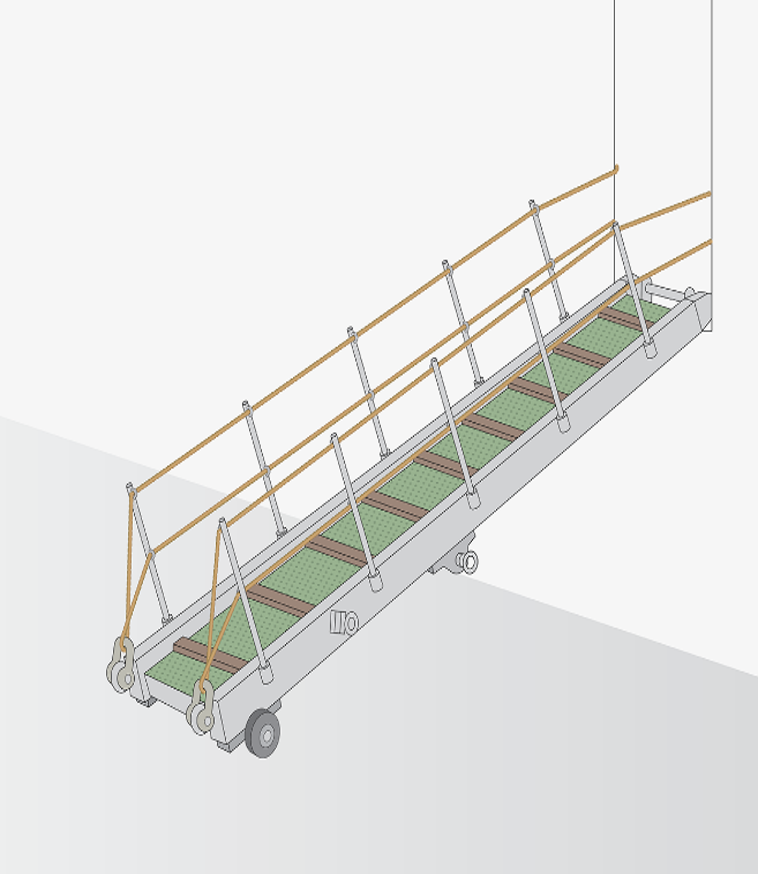
Gangway Type A
Maximum angle of 30 degrees. The decking is made of non-slip material with treads at regular spacing.
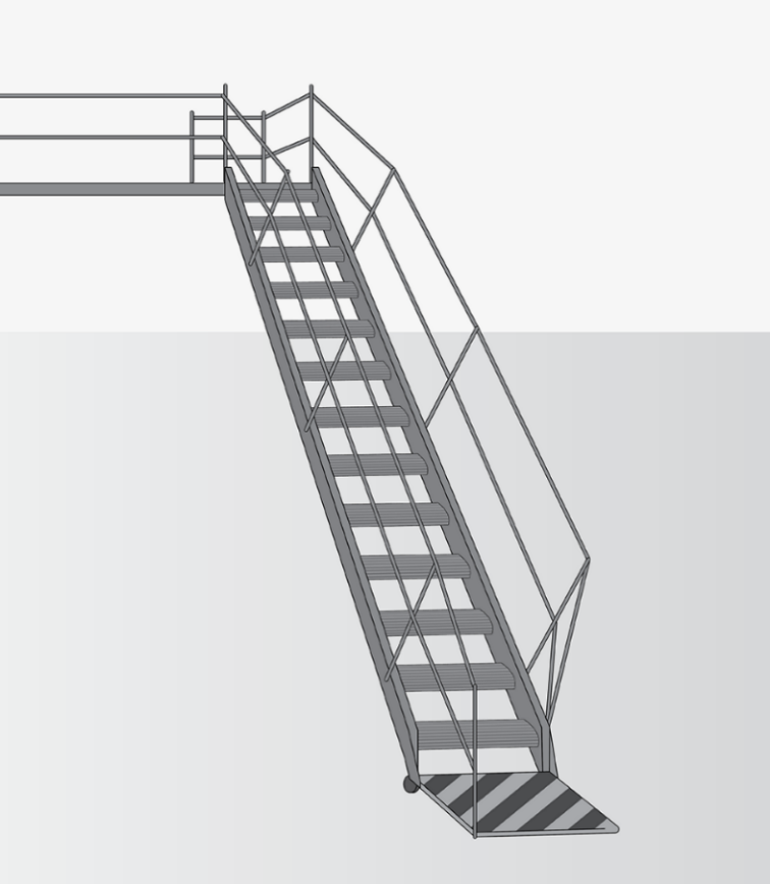
Accommodation ladder or Gangway Type B
Maximum angle of 55 degreesor as per the design specifications. Make sure you do not exceed the lower platform’s safe working load.
2.4 Combined access
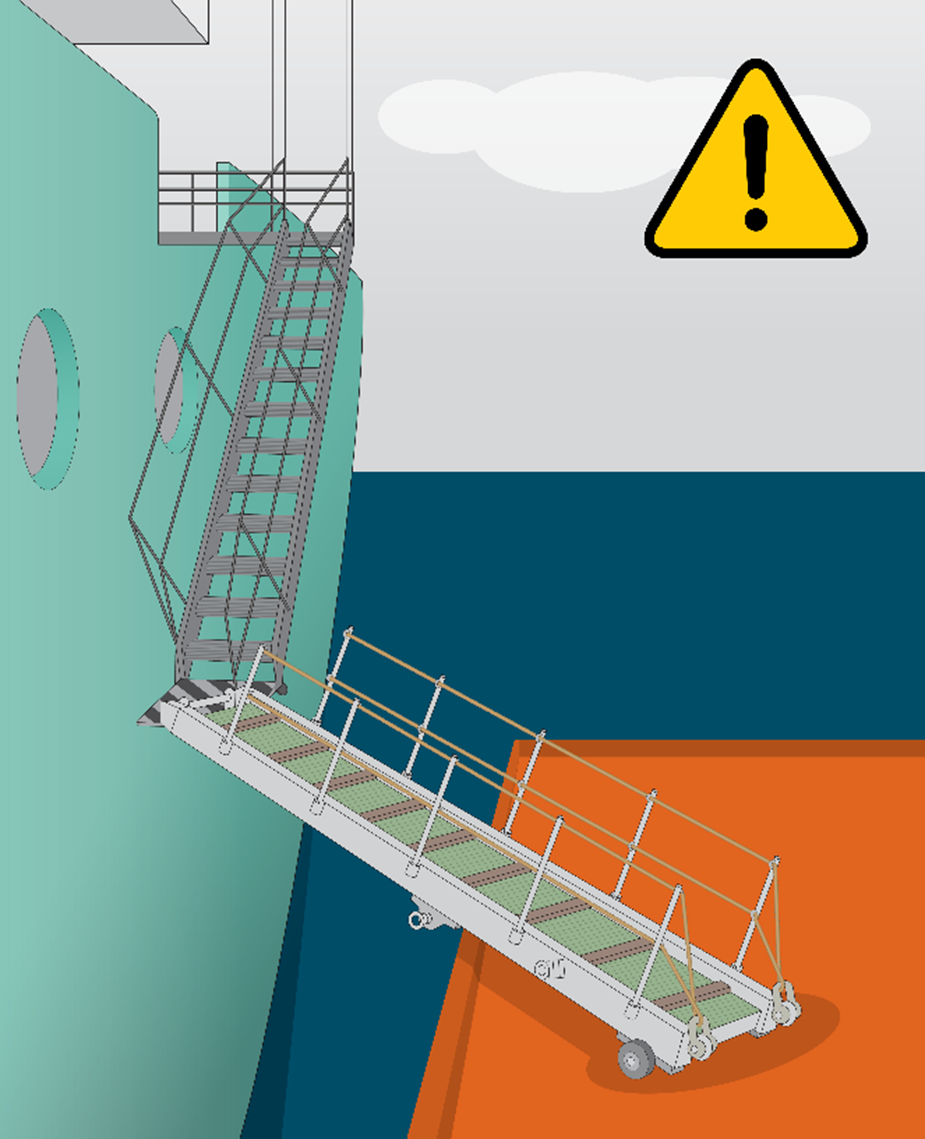
Using incompatible or makeshift combinations of gangways and ladders can lead to instability and accidents. Often, the means of access uses a combination of the ship's accommodation ladder and a gangway.
Accommodation ladders and gangways (type A and B) are designed and tested to be supported by solid surfaces. Installing a gangway on the suspended end (extension part) of a vessel accommodation ladder could lead to exceeding the permissible working load limit.
Make sure to pay special attention at the transition points between an accommodation ladder and a shore gangway.
2.5 Maintenance
All means of access must be regularly maintained and verified, according to applicable requirements and the manufacturer’s instructions.
Lifting equipment must be inspected, tested, and maintained. Pay special attention to the condition of all moving parts like cables, pulleys, and lifting winches. Moving parts must be able to turn freely and have enough grease, when needed.
For safety nets, refer to Section 2.7 of this document.
You will need to address any distortion, cracks, wear, or corrosion you find. You will also need to replace or repair any damaged parts.
All repair, verification, maintenance, inspection, or testing work must be logged and available to view.
2.6 Handrails
Clarifying the type of handrail is key for safety. While some sections feature "flexible" handrails like ropes or cables, these provide inconsistent support due to changes in rope tension and the level of support needed to balance. These areas usually present the highest risk of falling over the railing
Ashore equipment typically feature rigid handrails, like solid pipes. These rigid handrails provide stable and consistent support, which significantly reduces the risk of falls compared to flexible handrails like ropes or cables.
As specified above, access usually involves equipment that belongs to the ship and other pieces that belong to the port. As such, it’s common to have a part of that equipment with a rigid handrail and another part with a flexible handrail. The risks of these variations can increase in conditions like bad weather or poor visibility. It can be hard for a user to see and anticipate that the handrail support will change along the length of the access to the vessel.
2.7 Safety nets
Safety nets help protect against falls, drowning, and being crushed between the dock and the vessel. Here are a few key points:
- Regulations: Section 17 of the Marine Occupational Health and Safety Regulations requires that safety nets on Canadian vessels follow the ANSI/ASSE A10.11-1989 (R1998) standard
- Foreign Vessels: Employers must make sure that safety nets on foreign vessels meet the required standards or provide proof that they meet the standards of a recognized organization
- Exceptions: Paragraphs 12(9)(a) and (b) of the Marine Occupational Health and Safety Regulations and sections 56(1)a) and b) of the Safe Working Practices Regulations allow exceptions when necessary, ensuring that safety practices stay reasonable and achievable
- Eliminating risks: If the design of the access removes the risk that a safety net would address, then a net is not required
- Installing issues: If it is not possible to install a safety net due to the vessel’s design or other limitations, then the requirement doesn’t apply
2.7.1 Requirements
These rules make sure safety nets are strong and reliable to help protect people from falls. The standard ANSI/ASSP A10.11-1989 (R1998) outlines the following:
- Materials: Safety nets can be made from natural or synthetic fibers. The materials must last at least two years and be able to handle tough conditions like bad weather, chemicals, dirt, and sunlight (UV exposure)
- Installation: Nets should be installed in a way that reduces bouncing if someone falls into them
- Support structure: The support system and connection points must be strong enough to catch someone who weighs up to 159 kg (350 lbs)
Identification and documentation
- Each net needs a permanent tag showing the manufacturer’s name, type of material, date it was made, date of prototype testing, name of the testing organization, and a serial number
- A qualified person must inspect the nets, and the inspection results must be written down in a logbook kept on the vessel or at the port terminal
-
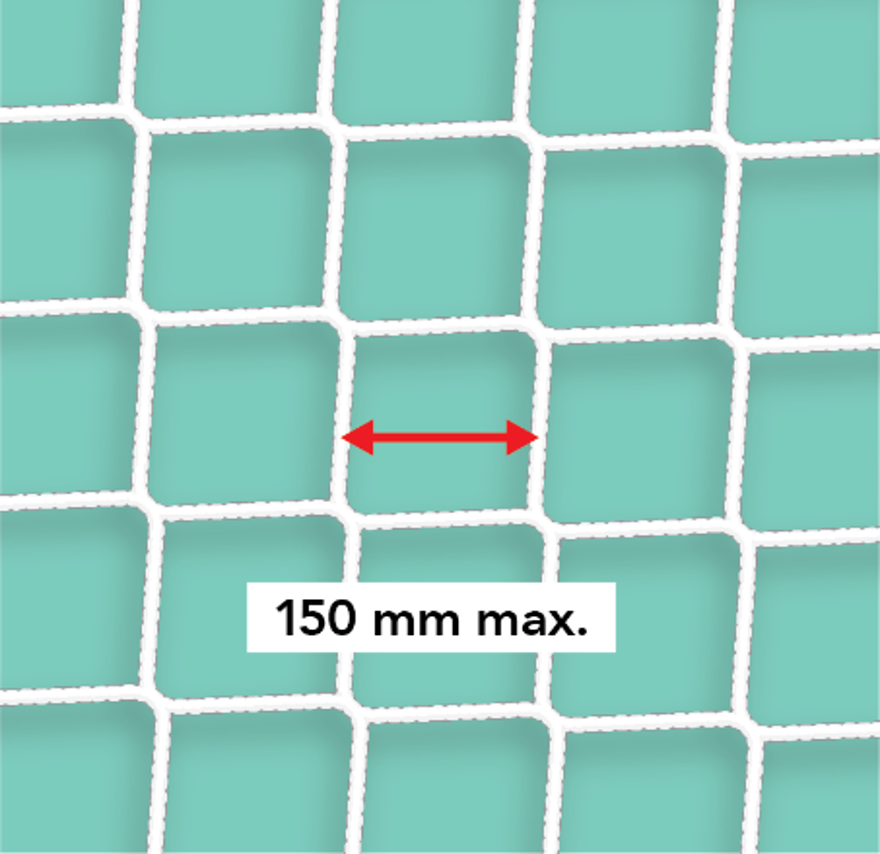
The mesh “cells” must be 150 mm (6 in) or less. The mesh crossing must be made in a way that limits wear and tear from friction and prevents the mesh from widening.
2.7.2 Installation
Safety nets must be rigged and maintained in a way that's both effective and meets the required standards. Here are a few key points:
Rigging and maintenance
- Be sure to factor-in vessel movement due to loading, unloading, tide changes, swell, and surge movements caused by ships nearby
- Attach the net as close as possible to the underside of the gangway
- Make sure the net isn’t too tight. It needs enough slack to absorb the weight of a person and keep them from bouncing off
- Avoid tying the net directly to the dock unless it’s monitored regularly
Attachment and support
- Equip the net with hooks, safety shackles, or equivalents to support a person’s weight and make it easy to attach
- Make sure anchor points are no more than 1.22 m (4 ft) apart
- Design attachments to keep them from disconnecting
- The following images show how to install a net, depending on the type of access you’re using.
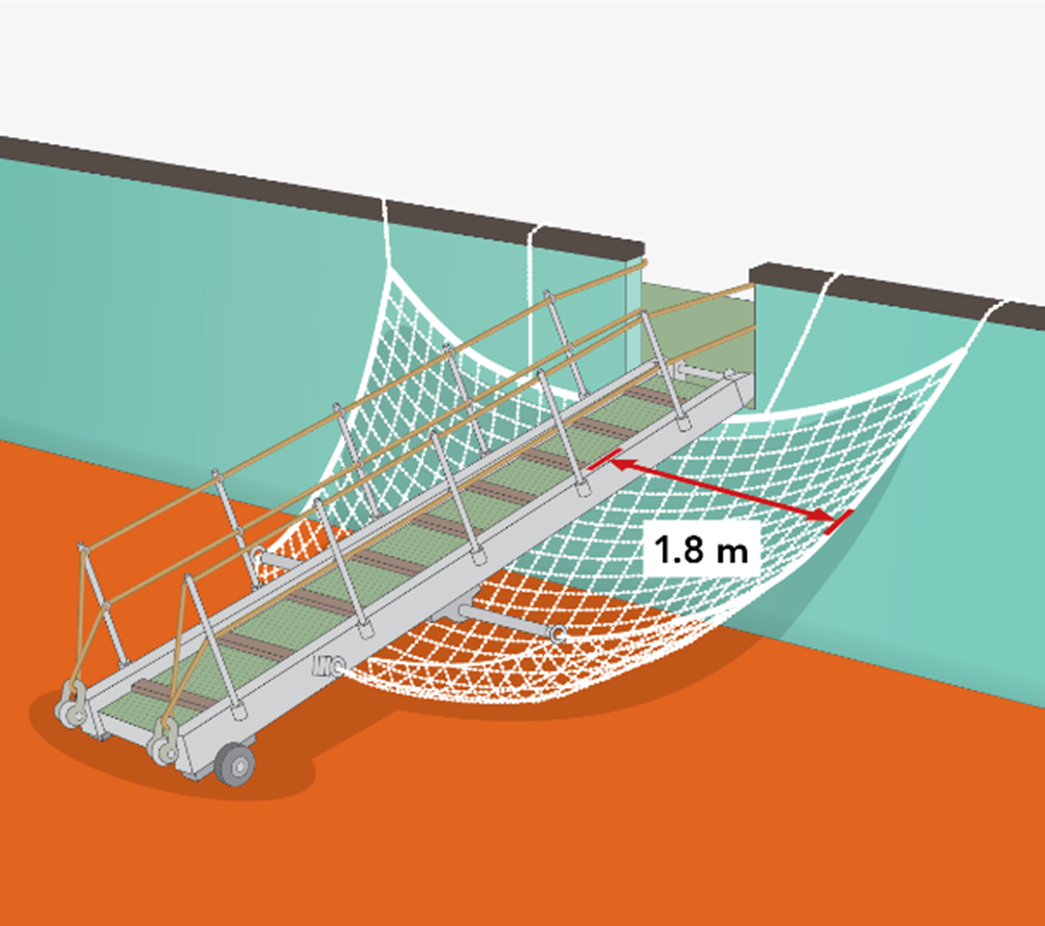
- For gangways fixed at a right angle (perpendicular) to the vessel
- According to paragraph 12(10)(a) of the Marine Occupational Health and Safety Regulations, the net must:
- extend to both sides of the ladder or gangway for a distance of at least 1.8 m (6 ft)
- be kept taut at all times, and
- protect the entire length of the means of access, as much as possible
- For an accommodation ladder installed along the lengthwise (longitudinal) axis of the vessel
- The Marine Occupational Health and Safety Regulations does not have specific requirements for accommodation ladders installed parallel to the vessel. This orientation can make it difficult to install a safety net, especially due to the requirement to have the net extend at least 1.8 m on both sides of the ladder.
- You must protect users from falling. To protect people, it’s important to use and monitor either solid or properly tensioned guard rails.
- Transport Canada suggests installing the safety net as shown in the following pictures.
-
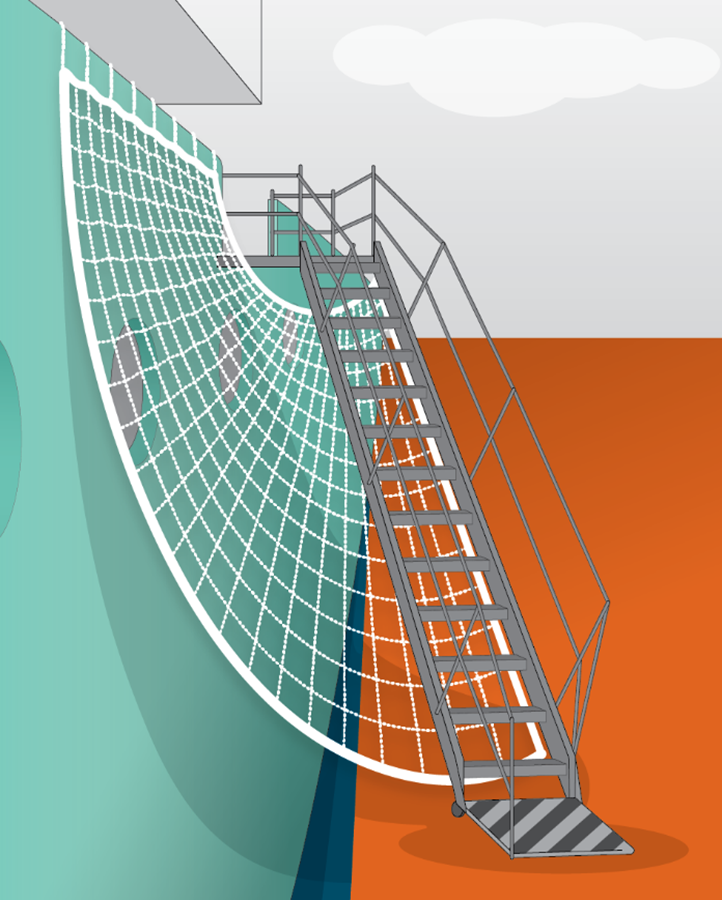
Picture A
Accommodation ladder installed along the lengthwise (longitudinal) axis of the vessel.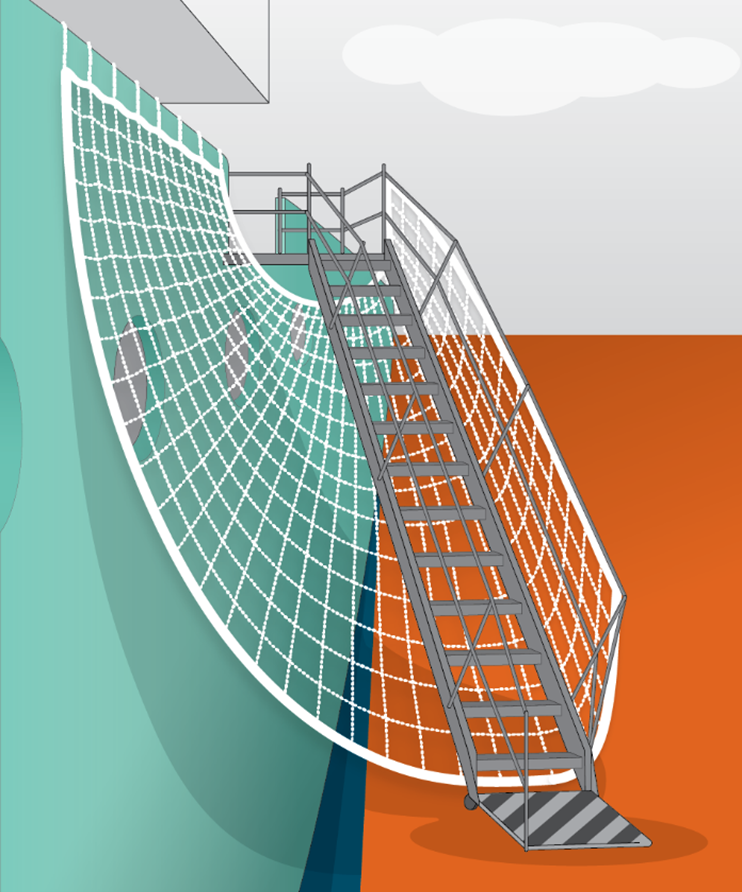
Picture B
Accommodation ladder installed along the lengthwise (longitudinal) axis of the vessel. - You should make sure that the net covers the entire area where a fall could occur, including the space between the vessel and the dock.
- Instructions for attaching safety nets to accommodation ladders help make sure the safety net is effective and does not interfere with the handrail. Here are a few key points to consider:
Attachment methods
- Picture A: The net’s inner edge is attached to the vessel’s side, passes under the ladder, and is attached to the outer edge (dock side).
- Picture B: The net’s inner edge is attached to the vessel’s side, passes under the ladder, and the outer edge is attached under the top of the outer handrail.
Key factors
- Ensure the handrail can support a person weighing 159 kg (350 lbs).
- The net’s attachment points should not obstruct the handrail, allowing a person’s hand to travel its length without interruption.
- Avoid wrapping ropes around the handrail, which can create obstructions. Instead, fix anchor points under the handrail.
Dock attachment
- The net can be attached to fixed points on the dock if secured to the vessel.
- Regular monitoring is necessary to maintain proper tension
Improper installation
Installing a safety net only from handrail to handrail, as shown below, does not protect people from falling between the vessel and the dock. As such, do not install nets this way.
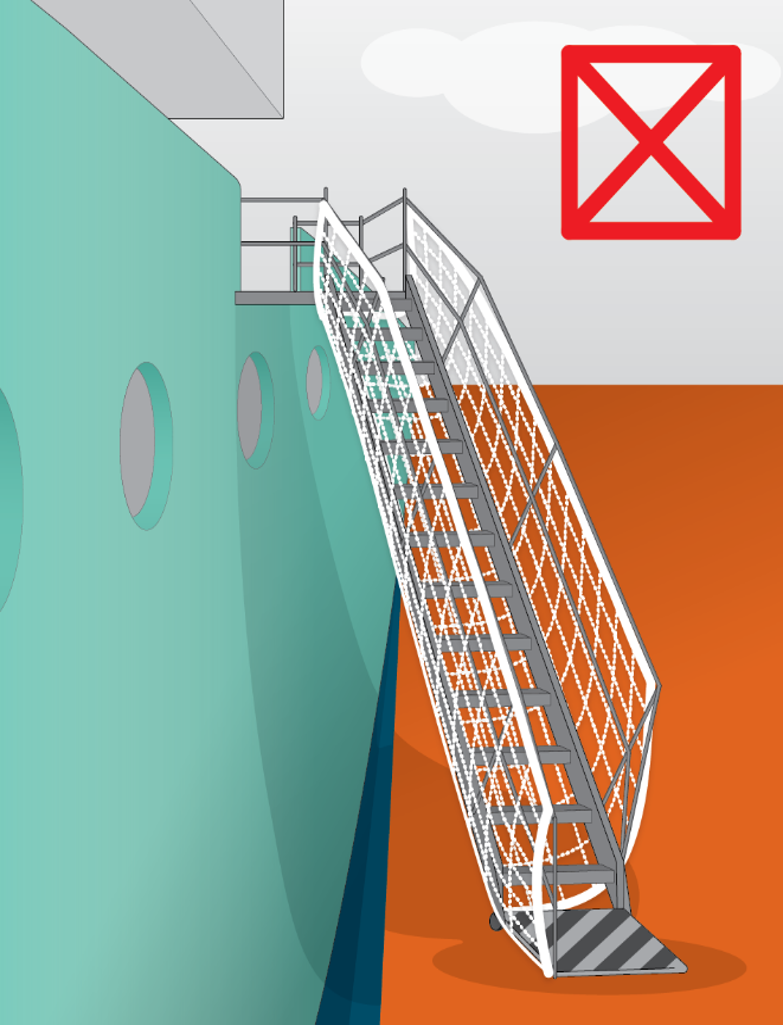
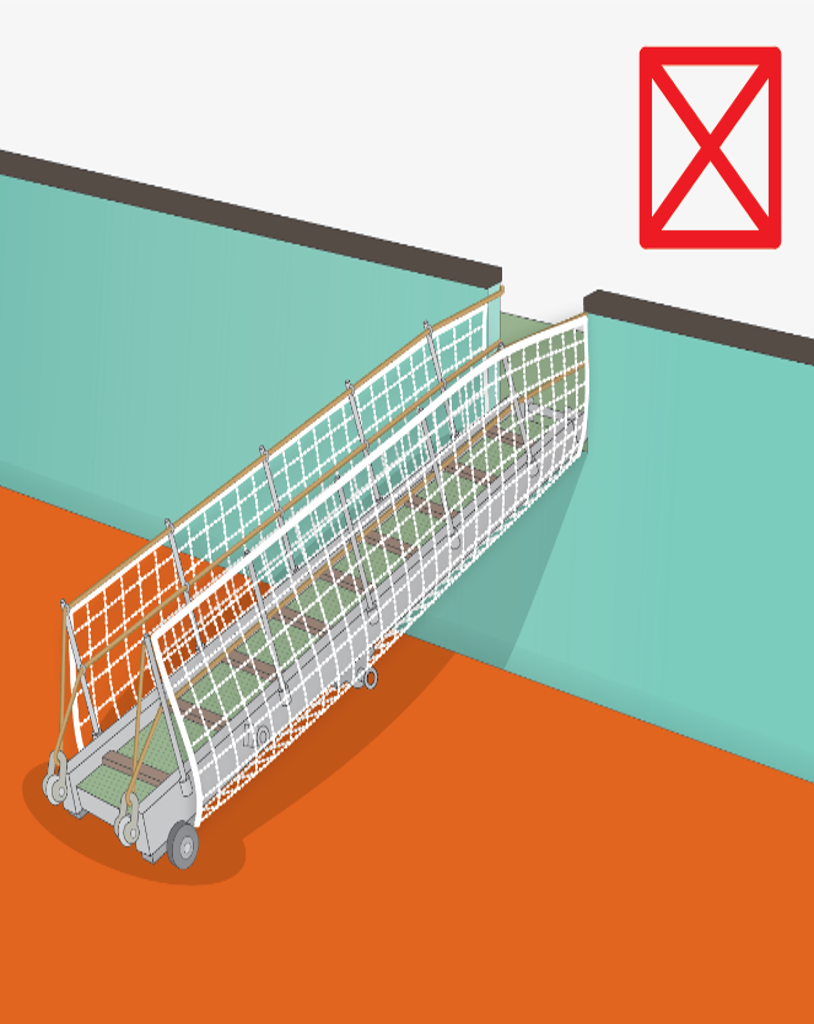
These images show safety nets that have been poorly installed. The nets don’t provide enough protection from falls between the dock and the vessel.
2.7.3 Maintenance tips for safety nets
Here are a few maintenance tips to help make sure your safety nets stay effective and last longer.
- Avoid prolonged exposure to sunlight or severe weather
- Stow the net indoors in a dry place
- Keep the net away from hot work or welding slag
- Don’t let the net rub against hard surfaces or objects
- Avoid contact with chemicals that could weaken the mesh
- Only use the net only for its intended purpose
2.7.4 Safety net inspections
Regular inspections by a qualified person will help make sure the net is in good condition and safe to use.
Items to monitor
- Mesh of the net
- Rope around the net
- Hardware
- Attachment points
- Means of attachment
Types of damage to check for
- Abrasion damage
- Corrosion/wastage
- Exposure
- Deterioration
- Decay
How to address damage
- Remove the net from service or repair it if damaged
- Perform a test after repairs
- Record the inspection and repair details in a dedicated logbook
3.0 Conclusion
This document explains the common rules and equipment used to help people safely move between a ship and the shore.
Some of these practices may not work in some cases, like with smaller vessels or when moving between two ships. In other cases, some risks remain. These situations should be handled by following Part 7 of the Marine Occupational Health and Safety Regulations or section 106 of the Canada Shipping Act, 2001. This will help you make sure that plans and emergency steps are ready and clear.
Part 7 of the regulations says that you must have a hazard prevention program in place. This program should help you:
- find and assess risks
- come up with ways to lower the risks and consider help from a qualified person
- train workers on safe work procedures and
- evaluate your program
These steps are key when thinking about how to safely get on and off a vessel. The program should also include the help and input of the workplace health and safety representative or committee.
Following these rules and practices can improve safety and help operations run smoothly. This protects everyone involved in getting on and off a vessel.

TP 15697 – Means of safe access to a vessel
(PDF, 1.26 MB)