
Subject: Multi-Crew Cooperation (MCC) Training
| Issuing Office: | Civil Aviation, Standards |
|---|---|
| Document No.: | AC 406-003 |
| File Classification No.: | Z 5000-34 |
| Issue No.: | 01 |
| RDIMS No.: | 19619196-v12 |
| Effective Date: | 2026-06-01 |
Table of contents
- 1.0 Introduction
- 2.0 References and requirements
- 3.0 Background
- 4.0 Training objectives
- 5.0 Competencies
- 6.0 Training and assessment
- 7.0 Training program
- 8.0 Flight Simulation Training Devices (FSTDs)
- 9.0 Information management
- 10.0 Document history
- 11.0 Contact us
- Appendix A – Transport Canada NOTECHS
- Appendix B – LOFT Scenario Example
1.0 Introduction
- (1) This Advisory Circular (AC) is provided for information and guidance purposes. It describes an example of an acceptable means, but not the only means, of demonstrating compliance with regulations and standards. This AC on its own does not change, create, amend, or permit deviations from regulatory requirements, nor does it establish minimum standards.
1.1 Purpose
- (1) To provide guidance to Flight Training Units on the implementation and delivery of MCC training programs required by Standard 426.75(5)(d)(v)(B) of the Canadian Aviation Regulations.
- (2) To elaborate on the goals and objectives of MCC training conducted under Part IV of the CARs.
- (3) To guide the development of minimum FSTD requirements that support MCC training goals.
1.2 Applicability
- (1) This document applies to all Transport Canada Civil Aviation employees, to individuals and Flight Training Units conducting Integrated Pilot Training pursuant to section 406.75 of the CARs and students enrolled in those courses. This information is also available to the aviation industry for information purposes.
1.3 Description of changes
- (1) Not applicable.
2.0 References and requirements
2.1 Reference documents
- (1) It is intended that the following reference materials be used in conjunction with this document:
- (a) Part IV, Subpart 6 of the Canadian Aviation Regulations (CARs) – Flight Training Units
- (b) Standard 426 of the CARs – Flight Training Units
2.2 Cancelled documents
- (1) Not applicable.
2.3 Definitions and abbreviations
- (1) The following definitions are used in this document:
- (a) Behavioural Markers: An observable behaviour or set of behaviours indicative of some aspect of performance. (Transport Canada, 2020)
- (b) Competency: A dimension of human performance that is used to reliably predict successful performance on the job. A competency is manifested and observed through behaviours that mobilize the relevant knowledge, skills, and attitudes to carry out activities or tasks under specified conditions. (ICAO, 2020)
- (c) Competency-Based Training and Assessment (CBTA): Training and assessment that are characterized by a performance orientation, emphasis on standards of performance and their measurement, and the development of training to the specified performance standards. (ICAO, 2020)
- (d) Competency Element: An action that constitutes a task that has a triggering event and a terminating event that clearly defines its limits, and an observable outcome. (ICAO, 2013)
- (e) Competency Unit: A discrete function consisting of a number of competency elements. (Kearns, Mavin, & Hodge, 2020)
- (f) Competency Standard: A level of performance that is defined as acceptable when assessing whether or not competency has been achieved (ICAO, 2020). A person is said to be competent when their proficiency meets or exceeds the competency standard. (Original definition)
- (g) Countermeasures: Actions performed by flight crews to keep threats, errors, and undesired aircraft states from reducing margins of safety in flight operations. (Maurino, 2005)
- (h) Crew Member: means a person who is assigned to duty in an aircraft during flight time, or assigned to duty related to the operation of a remotely piloted aircraft system during flight time. (Subsection 101.01(1) of the CARs)
- (i) Crew Resource Management (CRM): is the effective use of all resources including crew members, aircraft systems, supporting facilities and persons to achieve safe and efficient operations. The objective of CRM is to enhance communication, interaction, human factors, and management skills of the crew members concerned. Emphasis is also on the non-technical aspects of crew performance. (Transport Canada, 2020)
- (j) Error: An action or inaction by an operational person that leads to deviations from organizational or the operational person’s intentions or expectations. (ICAO, 2020)
- (k) Error management: The process of detecting errors and responding to them with countermeasures that reduce or eliminate the consequences of errors and mitigate the probability of further errors or undesired states. (ICAO, 2020)
- (l) Flight Simulation Training Device (FSTD): means an apparatus, including synthetic flight training equipment that replicates or emulates an aircraft or aircraft component for the purpose of pilot training and checking. The term refers to both a full flight simulator (FFS) and a flight training device (FTD). (Transport Canada, 2019)
- (m) Human Factors: Is concerned with the application of what we know about human beings, their abilities, characteristics, and limitations, to the design of equipment they use, environments in which they function and jobs they perform. It includes the contribution of human performance to overall system performance. (ICAO, 2021)
- (n) Human Performance: refers to how people perform tasks based on: their capabilities and limitations; their different interpretations to situations; their adaptations to a complex and dynamic work environment; their ability to assess risks and make trade-offs; and how their performance is influenced by working with other people, technology and the environment. (ICAO, 2021)
- (o) Inter-rater reliability: The consistency or stability of scores between different raters. (ICAO, 2013)
- (p) Line-Oriented Flight Training (LOFT): is a training session conducted in a simulated but realistic operational environment using a Transport Canada approved FSTD. LOFT is conducted with a complete flight crew using representative flight segments that progress in real-time and contain events that may be expected in line operations. These events require the application of normal, non-normal, abnormal, or emergency procedures, and provide opportunities to learn and practice effective CRM. Original definition adapted from (FAA, 2015) and (Transport Canada, 2005).
- (q) Multi-crew: refers to the operation of an aircraft by two or more pilots who coordinate their activities and cooperate on the completion of tasks using Standard Operating Procedures. This is unrelated to the minimum crew requirement established during aircraft type certification. (Original definition)
- (r) Non-Technical Skills: Non-technical skills are not directly related to the control of equipment and technical proficiency. They encompass aspects of behaviour such as cognitive skills and interpersonal skills (Transport Canada, 2020). Non-technical skills are distinct from the “NOTECHS” behavioural marker framework also discussed in this document.
- (s) NOTECHS: is a behavioural marker framework developed by the JAA Project Advisory Group on Human Factors in 1998 that was adopted into JAR OPS regulations in 2001. It was designed to be an efficient method of evaluation of non-technical (CRM) skills that would minimize cultural and corporate differences (Flin, et al., 2003). In this document, “NOTECHS” refers specifically to this framework and is not an abbreviation of “non-technical skills”.
- (t) Proficiency: The degree of skill or level of performance that can be reliably demonstrated by an individual in the performance of a task. When proficiency meets or exceeds the competency standard, the person is said to be competent. (Original definition)
- (u) Standard Operating Procedures (SOPs): are a set of procedures established by an aircraft operator that enable the crew members to operate the aircraft within the limitations specified in the aircraft flight manual and, for commercial air services, that meet the Commercial Air Service Standards. (Original definition)
- (v) Threat: Events or errors that occur beyond the influence of an operational person, increase operational complexity, and must be managed to maintain the margin of safety. (ICAO, 2020)
- (w) Threat and Error Management: TEM is a general safety concept regarding aviation operations. Three basic components are ‘threats’, ‘errors’, and ‘undesired aircraft states.’ The TEM framework proposes that threats and errors are a part of everyday aviation operations that must be managed by flight crew, since both threats and errors have the potential to generate undesired aircraft states, which represents the last opportunity to avoid an unsafe outcome.” (Transport Canada, 2020)
- (x) Threat Management: The process of detecting threats and responding to them with countermeasures that reduce or eliminate the consequences of threats and mitigate the probability of errors or undesired states. (ICAO, 2020)
- (y) Training Organization: In this document, a training organization means a Flight Training Unit (FTU) or any organization authorized to conduct MCC training in Canada.
- (2) The following abbreviations are used in this document:
- (a) AC: Advisory Circular
- (b) ATP(A): Airline Transport Pilot (Aeroplane)
- (c) CARs: Canadian Aviation Regulations
- (d) CBTA: Competency Based Training and Assessment
- (e) CRM: Crew Resource Management
- (f) FSTD: Flight Simulation Training Device
- (g) FTU: Flight Training Unit
- (h) LOFT: Line Oriented Flight Training
- (i) MCC: Multi-Crew Cooperation
- (j) SOP(s): Standard Operating Procedure(s)
- (k) TEM: Threat and Error Management
2.4 Bibliography
-
(1) FAA. (2015, March 3). Advisory Circular (AC) No. 120-35D - Flightcrew Member Line-Operational Simulations: Line-Oriented Flight Training, Special Purpose Operational Training, Line Operational Evaluation. United States of America: Federal Aviation Administration.
-
(2) Flin, R., Martin, L., Goeters, K.-M., Hörmann, H.-J., Amalberti, R., Valot, C., & Nijhuis, H. (2003). Development of the NOTECHS (Non-Technical Skills) System for Assessing Pilots' CRM Skills. Human Factors and Aerospace Safety, 23.
-
(3) ICAO. (2013). DOC 9995 Manual of Evidence Based Training (1st ed.). International Civil Aviation Organization (ICAO).
-
(4) ICAO. (2020). Annex 1 Personnel Licensing (13th ed.). International Civil Aviation Organization (ICAO).
-
(5) ICAO. (2021). Manual on Human Performance (HP) for Regulators (First (Advance unedited) ed.).
-
(6) Kearns, S. K., Mavin, T. J., & Hodge, S. (2020). Competency-Based Education in Aviation. London and New York: Routledge.
-
(7) Klampfer, B., Flin, R., Helmreich, R. L., Häusler, R., Sexton, B., Fletcher, G., . . . Amacher, A. (2001). Enhancing Performance in High Risk Environments: Recommendations for the use of Behavioural Markers. Behavioural Markers Workshop. Zurich: Kolleg Group Interaction in High Risk Environments (GIHRE). Retrieved from https://hub.easa.europa.eu/crt/docs/viewcrdattachment/cid_16027/aid_237/fmd_3902d6107b8462a366188c5dc8a59fb1
-
(8) Lauber, J. K., & Foushee, H. C. (1981). Guidelines for Line-Oriented Flight Training. NASA/Industry Workshop held at NASA Ames Research Center. Volume II, p. 3. Moffett Field, California: NASA.
-
(9) Maurino, D. (2005). Threat and Error Management (TEM). Canadian Aviation Safety Seminar (CASS). Vancouver. Retrieved from https://www.skybrary.aero/sites/default/files/bookshelf/515.pdf
-
(10) Soll, H., Proske, S., Gesine, H., & Steinhardt, G. (2016, September). Decision-Making Tools for Aeronautical Teams: FOR-DEC and Beyond. Aviation Psychology and Applied Human Factors, pp. 101-112. Retrieved from https://www.researchgate.net/profile/Gesine-Hofinger/publication/309541971_Decision-Making_Tools_for_Aeronautical_Teams_FOR-DEC_and_Beyond/links/5a1aaac3a6fdcc50adeb1a4e/Decision-Making-Tools-for-Aeronautical-Teams-FOR-DEC-and-Beyond.pdf
-
(11) Transport Canada. (2005, June 2). Development and implementation of an Advanced Qualification Program (AQP). Policy Letter No. 169. Ottawa, Ontario, Canada: Transport Canada.
-
(12) Transport Canada. (2017). TP 6533 Approved Check Pilot Manual (10th ed.). Ottawa: Transport Canada.
-
(13) Transport Canada. (2019). TP 9685 Aeroplane and Rotorcraft Simulator Manual (3rd ed.). Ottawa: Transport Canada.
-
(14) Transport Canada. (2020, March 14). Advisory Circular (AC) No. 700-042 - Crew Resource Management. (2). Canada: Transport Canada. Retrieved from https://tc.canada.ca/en/aviation/reference-centre/advisory-circulars/advisory-circular-ac-no-700-042
3.0 Background
- (1) MCC training was introduced into the Canadian Aviation Regulations (CARs) in 2006 as part of the integrated airline transport pilot (ATP(A)) training program standards.
- (2) Integrated ATP(A) courses are intended to prepare pilots to operate as a crew member on multi-crew, multi-engine aeroplanes in private operations or commercial air servicesFootnote 1. MCC training is intended to address the human factors inherent in such operations and develop pilot competencies to operate effectively, highlighting the importance of teamwork and shared responsibilities in the flight deck.
- (3) In Canada, a minimum of fifteen (15) hours of MCC training is required for ATP(A) integrated courses according to the StandardFootnote 2. This AC describes an acceptable method of demonstrating compliance with the Standard using a competency-based training and assessment (CBTA) approach and describes what learning objectives should be achieved.
- (4) A thorough discussion of CBTA is beyond the scope of this AC, however, key components of CBTA include:
- (a) Instructional design, training, and assessment that systematically references written competenciesFootnote 3.
- (b) A focus on performance as demonstrated through behavioural markers rather than on time spent doing a task or on completing a prescribed set of manoeuvres.
4.0 Training objectives
- (1) MCC training programs should develop competencies related to multi-crew operations by training students to apply knowledge of factors affecting human performance in a simulated private operator or commercial air service environment. This is a practical application of Human Factors.
- (2) Human factors aspects of Crew Resource Management (CRM) and Threat and Error Management (TEM) are particularly relevant. MCC training can be thought of as the practical application of CRM and TEM concepts.
- (3) MCC training programs should emphasize the development of non-technical competencies and the technical aspects of using standard operating procedures and checklists in multi-crew operations. Other training and evaluation events already focus exclusively on aircraft handling and rules of the air; therefore, these competencies are a prerequisite for MCC training, not an objective of it.
- (4) At a minimum, successful graduates of MCC training should demonstrate relevant multi-crew competencies to the level of proficiency necessary for entry into the initial training program of a multi-crew commercial or private air operation.
- (5) The fifteen hour minimum requirement for MCC training may not be sufficient for all learners to achieve the desired level of proficiency; training organizations are therefore encouraged to make more time available for MCC training as needed.
5.0 Competencies
- (1) Foundational to any CBTA program are the competencies that are identified and included in its design. Once identified, competencies are typically organized into frameworks around a particular job role, such as flight crew. Frameworks typically contain several competency units, which in turn consist of multiple competency elements. Competency elements have associated performance criteria that enable assessment.
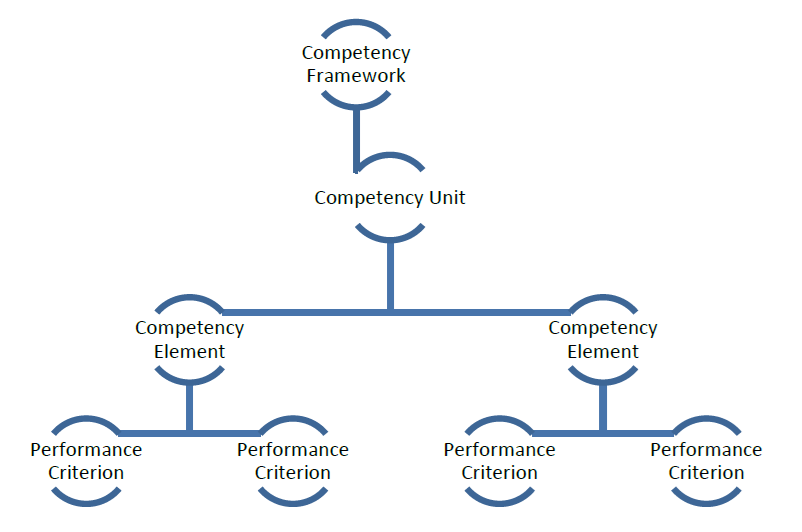
Figure 1 - The relationship between competencies, competency units, competency elements, and performance criteria
(Kearns, Mavin, & Hodge, 2020) - (2) The design of competency frameworks can be complex and time consuming and must be done with great care.
- (3) Transport Canada uses NOTECHS to assess pilots in commercial air services and it may also serve as a non-technical competency framework for MCC training. NOTECHS is a behavioural marker framework developed by the JAA Project Advisory Group on Human Factors in 1998 that was adopted into JAR OPS regulations in 2001. It was designed to be an efficient method of evaluation of non-technical (CRM) skills that would minimize cultural and corporate differencesFootnote 4.
- (4) NOTECHS predates CBTA and therefore uses different terminology for concepts that are similar but not identical to those in CBTA. The framework consists of four categories (competency units), which are subdivided into elements (competency elements), which are then broken down into behavioural markers (performance criteria). The four categories are: Cooperation, Leadership and Managerial Skills, Situational Awareness, and Decision-making. A description of these NOTECHS and associated behavioural markers appears in Appendix A.
- (5) ICAO DOC 9995 – Manual of Evidence Based Training (ICAO, 2013) contains a framework of core pilot competencies that has been widely accepted by air operators and civil aviation authorities around the world. This framework may also be used.
- (6) There may be benefits for a training organization to develop its own competency framework, in consultation with all relevant stakeholders, and create an MCC training program tailored for its own clientele. Such a program should always include a comprehensive list of crew behavioural markers needed to operate safely, effectively, and efficiently. Good behavioural markers describe a specific, observable behaviour, not an attitude or personality trait, with clear definition (enactment of skills or knowledge is shown in behaviour)Footnote 5. In addition, the level of performance must be specified and the context in which the behaviour takes place must be adequately describedFootnote 6.
- (7) Non-technical skills addressed by behavioural marker systems such as NOTECHS are also considered to be threat and error countermeasuresFootnote 7.
6.0 Training and assessment
- (1) MCC training is a learning tool and should not be seen as having objective pass/fail criteria that must be met as in manoeuvres training. Assessment, insofar as it is required, should be used only to determine whether the competency standard has been achieved; if not, additional training should be provided.
- (2) Training and assessment of competencies is accomplished through observation of behavioural markers that are indicative of effective practice or ineffective practice. It is important to note that the behavioural markers are only indicators of performance and are not intended to be used as a checklist.
- (3) It is not easy to clearly define a competency standard for non-technical skills and therefore it may be difficult to determine when a sufficient standard has been attained. Positive and negative formulations of behavioural markers (e.g., effective practices and ineffective practices, or good practices and poor practices) can be useful in this regard. In training situations, it is preferable to emphasize desired behaviours (effective practice) and encourage students to recognize and apply them more often; during assessment, the absence of undesirable behaviours (ineffective practice) may be sufficient to meet the competency standardFootnote 8. Appendix A provides examples of good practice and poor practice in the NOTECHS framework.
- (4) Transport Canada does not currently require the assessment of MCC proficiency under Part IV of the regulations; however, training organizations should define their own competency standard to assure the quality of their training and to meet the training objectives described in this AC.
- (5) When used to assess pilot proficiency under Part VII of the CARs, poor performance of non-technical skills alone is not permitted to trigger the failure of an assessmentFootnote 9; however, poor performance of non-technical skills may be the root cause or a contributing factor of a technical consequence that can trigger a failure of the assessment. In this case the primary purpose of the non-technical skill assessment is to help determine reasons behind the technical failure. It should be noted that the need for technical consequences is intended to act as a safeguard against arbitrary and inconsistent assessments.
- (6) The rating of non-technical skills is done at the competency unit (category) level. An unacceptable rating on any of the elements in a unit should always lead to an unacceptable rating for the unit. Unacceptable performance in any unit should indicate a need for additional training in that area. For example, using the NOTECHS framework, an unacceptable rating on the non-technical skill of “problem definition and diagnosis” should lead to an unacceptable rating of the “decision making” category and trigger additional training on decision making models, processes, and use of available resources.
- (7) Assessments should be based on multiple observations across multiple contexts; however, instructors and evaluators should report any observed unacceptable non-technical behaviour since the opportunities are rare for spotting such behaviour before it leads to an undesirable situation on the flight deck.
6.1 Instructor Qualifications
- (1) A critical factor in the implementation of any training system is preparing the users of the system with the knowledge of how to employ it. Consequently, the specification of training requirements for the qualification of instructors and evaluators who apply the system is essentialFootnote 10. At a minimum, instructors and evaluators should be able to:
- (a) Apply principles of competency-based training and assessment as described in this AC. Readers are also encouraged to consult the references listed in section 2.4 of this document.
- (b) Evaluate he competency framework and associated behavioural markers chosen by the training organization.
- (c) Apply principles of standardization and inter-rater reliability.
- (d) Apply principles of Line Oriented Flight Training (LOFT)
- (e) Apply student-centred briefing/debriefing techniques
- (f) Apply instructional techniques appropriate for LOFT
- (g) Evaluate Crew Resource Management (CRM), Threat and Error Management (TEM), and Pilot Decision-Making models.
- (2) To ensure that instructors’ and evaluators’ judgements are calibrated to achieve a high degree of inter-rater reliability, such personnel should attend regular standardization training to acquire the skills necessary to collect evidence in a systematic and reliable manner. Using video content to calibrate a group may be desirable for this purpose.
- (3) In addition to applicable regulatory requirements, including 425.21(3)(d), MCC instructors and evaluators should also meet the following experience requirements:
- (a) For the purposes of this AC, “aeroplanes required to be operated with a co-pilot” includes aeroplanes with a type certificate that specifies a minimum crew of one pilot but are operated with two pilots in a structured multi-crew SOP environment, as well as those aeroplanes with a type certificate that specifies a minimum crew of two pilots.
- (b) Have at least one year of operational experience as Pilot-In-Command in multi-crew operations; or
- (c) Have at least five years of operational experience as Second-In-Command in multi-crew operations; or
- (d) Have at least two years of experience as a synthetic flight instructor for a TCCA approved training program under CAR Part VI or VII.
6.2 Line Oriented Flight Training (LOFT)
- (1) MCC training should be conducted using a LOFT format. The key attributes of LOFT are:
- (a) It takes place in a Transport Canada certified FSTD.
- (b) It simulates a realistic operational environment.
- (c) It requires a complete flight crew. For the purposes of MCC training, a complete flight crew is one student for each pilot station who can satisfactorily accomplish the duties of that position.
- (d) It is training to proficiency. If the instructor identifies student performance deficiencies, additional training should be provided.
- (e) Flight crew interactions are based on Standard Operating Procedures (SOPs).
- (f) It consists of scenarios that are developed in advance and designed to promote the development of TEM and CRM competencies.
- (i) Scenarios should represent a complete flight, beginning with preflight planning, progressing through typical flight phases, and ending with engine shutdown.
- (ii) Scenarios include event sets that are allowed to unfold in real time. These events include routine, abnormal, and emergency situations that challenge the crew to think, act, and use their judgment effectively.
- (g) The instructor does not teach during the scenario- the teaching happens in the student-centred debriefing. The role of the instructor is to operate the FSTD, to act as ATC, dispatch, cabin crew, etc., and to observe individual and crew performance for discussion during the debriefing. The scenario must not be interrupted except in extreme and unusual circumstances.
- (h) The instructor will facilitate a thorough student-centered debriefing at the end of each scenario where individual and crew performance will be analyzed.
- (2) LOFT began in the mid-1970s as a way of providing pilot training that is more representative of actual flight operations than manoeuvre-based training alone. LOFT was soon recognized as a highly effective means of developing and practicing CRM skillsFootnote 11.
- (3) After examining the success of early LOFT programs, the FAA convened a working group of industry, FAA training personnel, instructors, and FAA inspectors that resulted in the publication of Advisory Circular 120-35, which was first published on May 24, 1978Footnote 12, and through several revisions remains a primary source for LOFT guidance today.
- (4) In Canada, LOFT was formally defined in Policy Letter (PL) 169. Published in 2005, PL169 established the basis for Advanced Qualification Programs (AQP) in Canada. LOFT subsequently appeared in exemption NCR-033-2016 and the associated AC 604-003 authorizing an alternate means of assessing pilot competency for private operators. Beyond this regulatory context, LOFT has been used informally by Canadian operators and flight training units for decades to develop and practice CRM skills.
- (5) LOFT is a learning environment in which errors are expected. While it is not the goal of LOFT to induce errors, the occurrence, detection, and mitigation of errors form an essential part of the training. Just as it is necessary to practice manual flightpath control in an FSTD or aircraft, so it is necessary to practice threat and error management skills in the presence of threats and errors.
- (6) It is beyond the scope of this document to present a full description of the design and implementation of LOFT scenarios. Readers are encouraged to consult the following sources for more information:
- (a) FAA. (2015, March 3). Advisory Circular (AC) No. 120-35D - Flightcrew Member Line-Operational Simulations: Line-Oriented Flight Training, Special Purpose Operational Training, Line Operational Evaluation. United States of America: Federal Aviation Administration
- (b) Transport Canada. (2005, June 2). Development and implementation of an Advanced Qualification Program (AQP). Policy Letter No. 169. Ottawa, Ontario, Canada: Transport Canada
- (c) Lauber, J. K., & Foushee, H. C. (1981). Guidelines for Line-Oriented Flight Training. NASA/Industry Workshop held at NASA Ames Research Center. Volumes I and II. Moffett Field, California: NASA
6.3 Student-Centered Debriefings
- (1) Student-centered debriefing refers to the process by which an instructor helps the students to analyze issues, learn from experience, and draw conclusionsFootnote 13. It is rooted in the Socratic Method of teaching and stands in contrast to instructor-centered debriefings, which can be one-sided lectures on everything the student(s) did wrong during the training event.
- (2) Student-centred debriefings include two parts: student self-assessment facilitated by the instructor, and a detailed debrief led by the instructor. The purpose of the self-assessment is to stimulate growth in the student’s thought process and, in turn, behavioursFootnote 14. This may be referred to in some sources as metacognition. The purpose of the instructor debrief is to compare the student’s self-assessment to the instructor’s assessment, and add other aspects of performance, good and bad, from the training event that were not previously discussed.
- (3) Student self-assessment should be facilitated by the instructor asking open questions that probe the learner’s understanding of the training just completed, including what went well, what could be improved, and what they would do differently next time. The questions should be asked in a way that elicits thoughtful conversation and avoids blame or defensiveness. Examples of open questions that probe a learner’s understanding include:
- (a) “What led you to make the decision to divert?”
- (b) “What cues were you using to judge how things were going?”
- (c) “What actions were most important at that point in the scenario and why? How was the workload managed?”
- (d) “Do you think you and the other pilot shared the same mental picture of what was happening at that moment? What clues were there that you did (or did not) share the same picture?”
- (4) The instructor-led debriefing should validate or correct the student’s self-assessment and address any remaining teaching points that were not already discussed. All feedback should be tied to CRM competencies and/or SOPs. While doing this, instructors should highlight strengths and reward good performance as this will set a positive tone for the debriefing and make students more receptive to how performance can be improved.
- (5) The time given to the instructor debrief relative to the student self-assessment should vary based on learner experience. An inexperienced learner will require more instruction (debrief) time, while an experienced learner may gain more from self-assessment (facilitation).
- (6) Self-monitoring is itself a skill, and students may need some pointers on how to self-monitor and self-critique. Student-centered debriefing supports development of self-monitoring skills by asking reflective questions and directing attention to individual and team performance cues, helping students to gradually internalize them. Research indicates that self-monitoring ability can develop over time and, importantly, that self-monitoring seems to improve performanceFootnote 15.
7.0 Training program
- (1) The following represents an acceptable means of compliance with the MCC training program standard that is consistent with the information presented in this AC.
7.1 Threshold knowledge
- (1) Students entering the MCC training program will have previously acquired the knowledge, skills, and attitudes to do the following:
- (a) Describe multi-crew concepts, including the use of SOPs, and the roles and responsibilities of the pilot flying (PF), pilot monitoring (PM), and other crewmembers.
- (b) Describe procedures for normal and non-normal checklists and explain any differences.
- (c) Describe CRM principles, including the behavioural markers that will be used to evaluate performance during MCC training.
- (d) Describe Threat and Error Management principles, including common countermeasures that can be employed to mitigate threats and errors.
- (e) Demonstrate operational procedures necessary to complete MCC training scenarios (e.g., instrument approach procedures).
- (f) Describe one or more communication strategies (e.g., PACEFootnote 16).
- (g) Describe one or more decision-making models (e.g., FOR-DECFootnote 17).
- (h) Demonstrate technical skills necessary to complete MCC training scenarios (e.g., programming of navigation equipment, use of automation, manual flight path control).
- (2) The list in paragraph (1) above uses verbs intentionally chosen from Bloom’s Taxonomy (2001).
7.2 Competencies
- (1) Using LOFT in a simulated private operator or commercial air service environment, apply multi-crew procedures including principles of TEM and CRM to the following:
- (a) Pre-flight preparation and dispatch
- (i) FMS initialization (if equipped)
- (ii) Radio and navigation equipment preparation
- (iii) Flight documentation
- (iv) Computation of take-off performance data
- (b) Take-off and initial climb
- (i) Before take-off checks
- (ii) Normal take-offs
- (iii) Rejected take-offs
- (iv) Take-offs with non-normal situations included
- (v) After take-off checks
- (c) Departure
- (i) Instrument or visual departure procedures as applicable to the type of operation
- (d) Cruise
- (i) Enroute navigation and diversion
- (ii) Emergency descent (pressurized aircraft only)
- (iii) Engine failure or shutdown
- (iv) Other system malfunctions
- (e) Descent and approach
- (i) Instrument approach procedures with or without flight director guidance
- (ii) Visual circuit procedures as applicable to the type of operation
- (iii) Missed approach or go-around procedures
- (iv) Holding
- (f) Landing
- (i) Normal landing
- (ii) Rejected landing
- (iii) Considerations with respect to runway condition, wind, and NOTAMs
- (iv) Considerations with respect to passenger evacuation after an emergency landing
- (a) Pre-flight preparation and dispatch
- (2) Training scenarios should include simulated ATC clearances that must be complied with.
- (3) Students should have the opportunity to act as pilot flying (PF) from both pilot stations (left and right seats).
7.3 Training outcomes
- (1) Upon completion of the MCC training program students will be able to:
- (a) Demonstrate multi-crew concepts, including the use of SOPs, and the roles and responsibilities of the pilot flying (PF) and pilot monitoring (PM).
- (b) Execute normal and non-normal checklist procedures, including effective crosschecking.
- (c) Demonstrate CRM principles, including, where appropriate, the behavioural markers from the chosen competency framework.
- (d) Identify threats and errors in a realistic operational context.
- (e) Implement countermeasures to mitigate threats and errors.
- (f) Demonstrate operational procedures necessary to complete MCC training scenarios (e.g., instrument approach procedures).
- (g) Demonstrate assertive communication.
- (h) Demonstrate effective decision making.
- (i) Demonstrate effective situational awareness
- (j) Demonstrate effective workload management
- (k) Demonstrate technical skills necessary to complete MCC training scenarios (e.g., use of navigation equipment, use of automation, manual flight path control).
8.0 Flight Simulation Training Devices (FSTDs)
- (1) TP 9685 Aeroplane and Rotorcraft Simulator Manual defines the minimum standard that FSTDs must meet to qualify for MCC trainingFootnote 18. In the event of any contradiction between TP 9685 and this AC, the version of TP 9685 currently in force is governing.
- (2) FSTDs used for MCC training must support the desired training outcomes. Most important among these is the ability for two students to act as a crew in a simulated flight deck with two pilot stations and a full set of primary flight instruments on both sides.
- (3) MCC training outcomes are not specific to an aeroplane type, therefore a type-specific device is not required; however, the device should aim to replicate, insofar as the training organization’s resources allow, the operational environment in which students can expect to find themselves after graduation.
9.0 Information management
- (1) Not applicable.
10.0 Document history
- (1) Not applicable.
11.0 Contact us
For more information, please contact:
Pilot Training and Licencing, Standards, AARTFL
E-mail: PilotLicensing-LicencesdePilote@tc.gc.ca.
We invite suggestions for amendments to this document. Submit your comments to:
AART Documentation Services
E-mail : AARTDocServices-ServicesdocAART@tc.gc.ca.
Original signed by Yvan Chabot for
Jamie-Lee MacDermid,
Executive Director, Standards Branch,
Civil Aviation
Appendix A – Transport Canada NOTECHS
The following has been reproduced from AC 700-042 (Transport Canada, 2020)
-
(1) The NOTECHS framework consists of four main categories: Co-operation, Leadership and Managerial Skills, Situational Awareness, Decision Making, each of them being subdivided into elements and behavioural markers (below). The latter are examples of effective and ineffective behaviours.
Category Elements Good Practice Poor Practice Cooperation Team building and maintaining - Establishes atmosphere for open communications and participation
- Blocks open communication
Considering others - Takes condition of other crew members into account
- Does not take account of the condition of other crew members
Supporting others - Helps other crew members in demanding situations
- Hesitates to help other crew members in demanding situations
Conflict solving - Concentrates on what is right rather than who is right
- Accuses other crew members of making errors
Leadership and managerial skills Use of authority and assertiveness - Takes initiative to ensure crew involvement and task completion
- Passive, does not show initiative for decisions, own position not recognizable
Maintaining standards - Intervenes if task completion deviates from standards
- Does not intervene in case of deviation
Planning and coordination - Clearly states intentions and goals
- Intentions not stated or confirmed
Workload management - Being aware of signs of stress and fatigue
- Inadequate workload planning
Situational awareness Awareness of aircraft systems - Monitors and reports changes in system states
- Does not ask for updates
Awareness of external environment - Contacts outside resources when necessary
- Does not enquire about environmental changes
Awareness of time - Discusses contingency strategies
- Does not set priorities with respect to time limits
Decision-making Problem definition and diagnosis - Reviews causal factors with other crew members
- No discussion of probable causes
Option generation - States alternative courses of action
- Does not search for information
Risk assessment and option selection - Considers and shares estimated risk of alternative courses of action
- Inadequate discussion of limiting factors with crew
Outcome review - Checks outcome against plan
- Fails to check selected outcome against goal
Note: The category ‘Communication’ is featured in a number of systems but is not shown in NOTECHS as a separate category. This is because communication skills are inherent in all four categories and the listed behaviours all involve communication.
- (2) Description of the four categories:
- (a) Co-operation: Defined as ‘the ability to work effectively in a team/crew’. Co-operation requires team building and maintaining, so that co-operative actions are based on mutual agreement by crew members in a positive group climate. Such a climate is also created by factors like consideration / support of other crew members and conflict solving skills. Co-operation deals with the question of how people function as a working group. It does not refer to the work itself, such as the quality/quantity of output.
- (b) Leadership and managerial Skills: Defined as: ‘effective leadership and managerial skills achieve joint task completion within a motivated, fully functioning team through coordination and persuasion’. The core of effective leadership is to set the highest priority on the joint completion of a given task. Leadership responsibilities include the active and goal-directed coordination of the working activities within the crew. This is always a reciprocal process. Without complementary behaviour of the crew, leadership behaviour is less effective. All crew members are expected to dedicate their efforts and initiative to the safe and efficient achievement of the flight goals.
- (c) Situational awareness: Defined as ‘one’s ability to accurately perceive what is in the cockpit and outside the aircraft’ (ICAO, 1989b, p13); or simply as ‘knowing what is going on’; or more precisely as, ‘the perception of the elements in the environment within a volume of time and space, the comprehension of their meaning, and the projection of their status in the near future’ (Endsley, 1995, p36). Shrestha, et al (1995, p.52) suggest an alternative version as a result of their review of ten definitions of situational awareness: ‘situational awareness is a dynamic, multifaceted construct that involves the maintenance and anticipation of critical task performance events. Crew members must also have temporal awareness, anticipating future events based on knowledge of both the past and the present. It is crucial that individuals monitor the environment so that potential problems can be corrected before they escalate.
- (d) Decision Making: Defined as ‘The process of reaching a judgement or choosing an option’. This definition of decision making is not generally disputed in the aviation literature although it may be labelled aeronautical decision making (Kaempf and Klein, 1995) or pilot judgement. Pilot decision making does not just involve one strategy - different types of decisions are made at different times. Decision events differ enormously in what they demand of the crew, what options and supports exist in standard procedures and policies for making decisions and in features that may make the situation complex. Orasanu (1993), a NASA research psychologist, has studied the styles of decision making used by pilots in different situations. ‘…crew decision making is not one thing. Crews make many different kinds of decisions, but all involve situation assessment, choice among alternatives, and assessment of risk.’ (p.138). Hence, pilots’ decisions differ in the degrees to which they call on various cognitive processes depending on the decision structure and task conditions.
Appendix B – LOFT Scenario Example
- (1) The following example is intended to introduce LOFT to readers who have limited or no experience delivering this type of training. It does not establish standards for content or formatting. The scenario and related materials are presented here in a series of tables, with paragraph text interspersed as required for explanation. This format has proven to be effective, however, there are likely other, equally effective formats. Whatever format is used, it is important that it is consistent and that a methodical development process is followed.
- (2) This scenario simulates a 705 airline operation conducting a scheduled IFR flight from Vancouver (CYVR) to Victoria (CYYJ). Weather conditions at departure and destination are low IFR and icing conditions exist in flight. The short flight, adverse weather, and a malfunction at destination are the primary drivers of CRM and TEM competency development for the student crew.
- (3) The scenario assumes a crew of two pilots consisting of a Captain (CA) and a First Officer (FO). Tables in this appendix may refer to each crew member by their rank (i.e., CA or FO), or by their role as Pilot Flying (PF) or Pilot Monitoring (PM). Crewmembers should maintain their rank as CA or FO throughout the scenario, however, crews may decide who is PF and PM at any time as the situation warrants.
- (4) In an actual MCC training program, this scenario would be one of several that together address all the training objectives.
- (5) Table B1, below, provides a quick reference for specific items to be accomplished during the LOFT and will help to ensure that all proficiency objectives identified in the training program are accomplished.
Table B1: Event Sets with Competencies Event Set Competency Unit – Element 1 – Preflight Planning and Briefing
Dispatch – Reduced/Low Visibility
Dispatch – Short Sector
2 – Taxi
Taxi – Reduced/Low Visibility
3 – Take-off
Take-off – Reduced/Low Visibility
4 – Climb and Cruise in Icing Conditions
Climb – Icing Conditions
Cruise – Icing Conditions
5 – Arrival in Icing Conditions
Arrival – Icing Conditions
Arrival – STAR
6 – Approach and Missed Approach with Malfunction
Approach – ILS
Approach – Missed Approach
Abnormal Operation – Landing Gear Fails to Retract
7 – Diversion to Alternate with Malfunction
Enroute Diversion – With Malfunction (Landing Gear Down)
Arrival – STAR
8 – Approach with Malfunction
Approach – With Malfunction (Landing Gear Down)
Approach – RNAV LPV
9 – Taxi and Parking
Taxi – Normal
Parking – Normal
Shutdown – With APU
Postflight – With Abnormal Event (Missed Approach, Malfunction, Diversion)
- (6) Table B2 is a profile of expected non-technical behavioural markers for each event set. It allows the script designer, training program manager, or auditor to see at a glance how thoroughly each competency is exercised in a given scenario. The competencies in this example are from the NOTECHS framework, however, a different framework could be used instead. This table highlights only the most salient behavioural markers to reduce the workload of the instructor. Other behavioural markers, whether effective or ineffective, may be noted during the scenario if desired. One of the strengths of the event set methodology is that it allows the instructor to focus on a limited set of CRM issues at a time, thus allowing the instructor to focus more attention on observing the crew.
Table B2: Profile of Selected Competency Units and Performance Criteria Event Set Number Cooperation Leadership and Managerial Skills Situational Awareness Decision-making 1 – Preflight planning and briefing
CA establishes atmosphere for open communication and participation
PF briefs arrival and approach procedure, in addition to take-off and departure, to mitigate high workload of short flight
Crew reviews reduced/low visibility taxi procedures, level of service, and take-off minima
Crew analyzes departure weather and verifies or requests take-off alternate
2 – Taxi
PM supports PF with awareness of taxi instructions.
N/A Crew observes taxi route and visibility requirements
N/A 3 – Take-off
N/A N/A Crew reviews minimum visibility required for take-off, and take-off alternate
N/A 4 – Climb and Cruise in Icing Conditions
N/A N/A Crew activates or verifies operation of anti-ice or de-icing equipment.
Crew discusses icing before it becomes a problem.
PF requests different altitude
5 – Arrival in Icing Conditions
PM supports PF to accomplish tasks on time
PF prioritizes tasks to complete approach preparation on time
Crew reviews destination and alternate weather
N/A 6 – Approach and Missed Approach with Malfunction
PM supports PF through approach and missed approach
PF prioritizes flight path management
PM points out landing gear malfunction
N/A 7 – Diversion to Alternate with Malfunction
PM supports PF with appropriate checklists and as requested
PM briefs cabin, company, and ATC
CA uses authority and assertiveness effectively
Crew prioritizes tasks effectively
PM calculates time/distance/fuel to alternate with landing gear down
CA assesses diversion options, asks for and receives input, but makes a decisive final decision
8 – Approach with Malfunction
N/A N/A Crew briefs non-standard approach and missed approach with landing gear malfunction
N/A 9 – Taxi and Parking
N/A Crew discusses next steps following diversion (e.g. passenger accommodation, safety report, etc.)
N/A N/A - (7) Table B3 summarizes key events along with technical requirements and CRM behaviours. It also includes a difficulty score to ensure a consistent level of difficulty between scenarios.
Table B3: Event Set Summary Event Set Key Details Difficulty 1 – Preflight planning and briefing
Icing conditions on route at planned cruising altitude.
Departure RVR is at operational minimum.
Destination weather is at CAT I minimum.
Alternate weather is IFR.
2
2 – Taxi
Taxi in minimum operational visibility.
2
3 – Take-off
Take-off in minimum operational visibility.
2
4 – Climb and Cruise in Icing Conditions
Moderate icing conditions exist during climb and at planned cruising altitude.
1
5 – Arrival in Icing Conditions
Light to moderate icing in descent.
2
6 – Approach and Missed Approach with Malfunction
CAT I ILS approach to minimums (no visual reference).
Missed approach.
Landing gear fails to retract in the missed approach.
3
7 – Diversion to Alternate with Malfunction
Origin and destination weather are below CAT I minima.
Alternate weather is 100’ and 1SM above non-precision minima.
3
8 – Approach with Malfunction
Non-precision approach at alternate.
2
9 – Taxi and Parking
Normal operation.
1
Total difficulty score
18
- (8) Table B4 contains the scenario script. The script is designed as a step-by-step guide for the instructor to follow from the beginning of the scenario to the end. As LOFT is a student-led exercise where crews are free to make decisions that may change the course of the scenario, the script cannot cover all possible outcomes and instructors should be prepared to adlib as necessary. However, a well-designed scenario will lead the students through the intended training objectives while still allowing them to make their own decisions.
- (9) Each event set in the scenario is identified within the script to facilitate assessment as well as to organize the supporting information. Each event set contains several events, and each event has the following components: event number, actor, trigger, action, and optional notes or instructions. Referring to the following example event:
6.4 Instructor After crew lowers landing gear
Arm malfunction to trigger on gear retraction: Landing Gear Fails to Retract
Malfunctions->Landing Gear->Landing Gear Fails to Retract- (a) The event number is 6.4, corresponding to the fourth event of set six.
- (b) The actor in this example is the instructor. In other events it may be a controller on a radio frequency (e.g. YVR CTR 132.9), as simulated by the instructor. This is who will perform the action in this event.
- (c) The trigger in this example is the crew lowering the landing gear. This is when or where the action in this event will take place.
- (d) The action in this example is to arm a malfunction using the FSTD instructor operating station (IOS). This is what the actor does when the trigger condition is met.
- (e) This example includes optional instructions on how to arm the malfunction. This helps reduce workload on instructors. Other events may include a note to instructors, such as why a certain action is required.
- (10) The script also identifies certain “checkpoints” within the scenario. Typically, these are transitions between phases of flight, such as take-off, approach, and landing. Easily identifiable checkpoints help the reader quickly orient themselves within the script and facilitate auditing by making it easier to count the number of take-offs, landings, approaches, etc. within a training program. Checkpoints also offer an opportunity for the script designer to estimate the elapsed time (EET) when the checkpoint will occur. This provides situational awareness to the instructor on how the scenario is progressing within the allotted time. The following checkpoint example shows an ILS approach that is estimated to occur one hour and fifteen minutes into the scenario.
approach (ILS) [EET 01+15]
- (11) Planned malfunctions can also be considered a kind of checkpoint, and they are clearly identified within the script for the same reasons of helping to orienting the reader and facilitate auditing. Malfunctions may be colour coded according to their severity. This example shows a landing gear malfunction in amber since it is a non-critical malfunction.
Landing gear fails to retract
Table B4: Scenario Script
Event Set 1 – Preflight Planning and Briefing
1.1 Instructor Prior to entering the FSTD
Provide crew with a flight plan and weather package for a flight from CYVR to CYYJ with KSEA as the destination and take-off alternate. The weather package should include realistic METAR, TAF, and enroute weather charts depicting the following:
- Departure weather at operational minima and forecast to decrease
- Destination weather at CAT I minima and forecast to decrease one hour after arrival
- Alternate weather is 100’ and 1SM above minima for a suitable non-precision approach
- Moderate icing in cloud forecast enroute within 2000’ of planned cruising altitude.
This event set ends with students having completed preflight planning, briefing, cockpit setup, and ready for pushback.
1.2 Instructor Upon entering the FSTD
FSTD Configuration checklist:
- Position aircraft at gate 75 in CYVR
- Set fuel to flight planned quantity
- Set aircraft weight and centre of gravity within normal range
- Set time of day: day
- Set departure visibility to the highest of:
- Minimum authorized by operator
- Level of service for the intended take-off runway
- Set departure ceiling to 100’ AGL
- Set precipitation to none
- Set surface temperature to 10°C
- Set surface wind to 10 kts favouring the preferred runway
- Set cloud layer from 10,000 to 14,000 ASL
Start of scenario [EET 00+00]
1.3 Crew Upon entering the FSTD
Carry out preflight duties up to requesting pushback clearance, as per SOPs.
1.4 YVR ATIS 124.6 Upon request
“YVR ATIS A@____Note: The blank space is a place for the instructor to write the actual time so the ATIS is “valid”. End noteZ (vis)SM FG OVC001 10/10 A2987 RUNWAY 26R. RWY26R RVR(rvr)”
Event Set 2 – Taxi
2.1 YVR GND 127.15 When crew requests pushback clearance
“XYZ Air, cleared to push and start engines. Call for taxi.”
2.2 YVR GND 127.15 When crew requests taxi clearance
“XYZ Air, runway 26R. Taxi S, M, M9. Hold short runway 26R”
2.3 YVR TWR 119.55 When crew stops at hold short line
“XYZ Air, line up at wait runway 26R”
Event Set 3 – Take-off
3.1 YVR TWR 119.55 When aircraft is lined up on runway, ready for take-off
“XYZ Air, RVR(rvr), cleared for take-off runway 26R. Contact departures 126.125 airborne.”
Take-off [EET 00+45]
3.2 YVR DEP 126.125 On initial contact
“XYZ Air, Vancouver departures; proceed direct Vancouver VOR on course; climb and maintain 14,000.”
Event Set 4 – Climb and Cruise in Icing Conditions
4.1 Instructor During initial climb
Verify or select moderate icing conditions in cloud
4.2 YVR DEP 126.125 Climbing through 8000’ ASL
“XYZ Air, contact Vancouver centre on 132.9”
4.3 YVR CTR 132.9 On initial contact
“XYZ Air, Vancouver centre roger.”
4.4 YVR CTR 132.9 When crew requests different altitude due to icing
“XYZ Air, cleared to maintain (requested altitude).”
4.5 YVR CTR 132.9 When established in cruise
“XYZ Air, contact Victoria Arrival on 125.45”
Event Set 5 – Arrival in Icing Conditions
5.1 YYJ ARR 125.45 On initial contact
“XYZ Air, Victoria arrival roger. Victoria ATIS is ALPHA; plan ILS runway 27.”
5.2 YYJ ATIS 118.8 Upon request
“YYJ ATIS A@____Note: The blank space is a place for the instructor to write the actual time so the ATIS is “valid”. End noteZ 1/2SM FG OVC003 14/14 A2989 RUNWAY 27”
5.3 Instructor After ATIS is received
Set ceiling at destination to zero but do not inform the crew. The crew should be expecting conditions as reported in the ATIS; however, they will not acquire visual reference to the runway and will have to execute a missed approach.
5.4 YYJ ARR 125.45 Approaching top of descent
“XYZ Air, cleared to descend to 8000, your discretion.”
5.5 Instructor During descent
Verify or select moderate icing conditions in cloud
5.6 YYJ ARR 125.45 Approaching ADSIK
“XYZ Air, maintain 3000.”
5.7 YYJ ARR 125.45 Approaching OBSOP
“XYZ Air, fly heading 185. Vectors for the ILS runway 27.”
Event Set 6 – Approach/Missed Approach with Malfunction
6.1 YYJ ARR 125.45 Prior to intercepting the localizer
Note: The instructor should provide realistic vectors as required to intercept the FAC.
“XYZ Air, fly present heading to intercept; cleared ILS runway 27 approach”
6.2 YYJ ARR 125.45 Upon intercepting the localizer
“XYZ Air, contact Victoria Tower now on 119.7”
Approach (ILS) [EET 01+15]
6.3 YYJ TWR 119.7 Upon initial contact
“XYZ Air, cleared to land runway 27”
6.4 Instructor After crew lowers landing gear
Arm malfunction to trigger on gear retraction: Landing Gear Fails to Retract
Malfunctions->Landing Gear->Landing Gear Fails to RetractMissed approach
Landing gear fails to retract
6.5 YYJ TWR 119.7 After crew reports in the missed approach
“XYZ Air, I check you’re in the missed approach. Contact Victoria Terminal now on 125.45.”
6.6 YYJ ARR 125.45 On initial contact
“XYZ Air, fly the published procedure and advise your intentions when able. Victoria ATIS is now BRAVO.”
6.7 YYJ ATIS 118.8 Upon request
“YYJ ATIS B@____Note: The blank space is a place for the instructor to write the actual time so the ATIS is “valid”. End noteZ 1/4SM FG VV001 14/14 A2989 RUNWAY 27”
Event Set 7 – Diversion to Alternate with Malfunction
Note: This script is designed to lead the crew towards diverting to KSEA; however, the crew must be allowed to decide their own course of action using all available resources, and the instructor must allow the crew’s decisions to unfold as realistically as possible. This may require deviating from the script.
7.1 YYJ ARR 125.45 When crew advises intentions
“XYZ Air, roger, I check you want to proceed to Seattle. Proceed present position direct JAWBN. Climb and maintain 17000.”
7.2 YYJ ARR 125.45 Climbing through 10,000’ ASL
“XYZ Air contact Vancouver centre on 132.9”
7.3 YVR CTR 132.9 On initial contact
“XYZ Air, Vancouver Centre, roger”
7.4 YVR CTR 132.9 At top of climb
“XYZ Air contact Seattle centre on 125.1”
7.5 SEA CTR 125.1 On initial contact
“XYZ Air roger. Seattle ATIS is ALPHA. Plan RNAV Y runway 34R”
7.6 SEA ATIS 118.0 Upon request
“SEA ATIS A@____Note: The blank space is a place for the instructor to write the actual time so the ATIS is “valid”. End noteZ 2SM BR OVC006 15/12 A2993 RUNWAY 34R”
7.7 SEA CTR 125.1 Approaching top of descent
“XYZ Air, descend via the JAWBN__ arrival.”
7.8 SEA CTR 125.1 At ALKIA
“XYZ Air, contact Seattle Approach on 133.65”
7.9 SEA APP 133.65 On initial contact
“XYZ Air, Seattle Approach. Proceed direct SONDR; Descend and maintain 5000.”
Event Set 8 – Approach with Malfunction
8.1 SEA APP 133.65 Approaching SONDR
“XYZ Air, via SONDR cleared for the RNAV Y runway 34R approach.”
8.2 SEA APP 133.65 Established on the Final Approach Course
“XYZ Air, contact Seattle Tower now on 119.9”
Approach (RNAV) [EET 01+50]
8.3 SEA TWR 119.9 On initial contact
“XYZ Air, cleared to land runway 34R”
Landing [EET 01+55]
Note: The crew may elect to have the aircraft inspected on the runway, or taxi to the gate. The instructor should go along with either choice and discuss the outcome in the debriefing.
8.4 SEA TWR 119.9 After landing
“XYZ Air, exit right and contact ground on 121.7”
8.5 SEA GND 121.7 On initial contact
“XYZ Air, taxi to the gate at your discretion”.
Event Set 9 – Taxi and Parking
End of scenario [EET 02+00]
-
(12) Table B5 contains a summary of supporting information. Items within parentheses are placeholders that should be replaced with information specific to the type of aircraft, operation, or training program. For example:
(Take-off performance data)
YVR ATIS A@____Note: The blank space is a place for the instructor to write the actual time so the ATIS is “valid”. End noteZ (vis)SM FG OVC001 10/10 A2987 RUNWAY 26R. RWY26R RVR(rvr)
(Take-off performance data) would be replaced with performance data that is specific to the type of aircraft and operation. (vis) and (rvr) would be replaced by visibility and RVR appropriate to the scenario or training program. The blank space (“@____Z”) is a place for the instructor to write the actual time so the ATIS is “valid”.
- (13) During LOFT, crews will have access to manuals, onboard libraries, and any other source of information that they would normally have access to during flight. In addition, supporting information will be provided to the crew in a format similar to how it would be available during flight. The information should be presented in a manner that is as realistic as possible with respect to the operation and the type of aircraft simulated. For aircraft with an ACARS printer, the instructor may provide printed information simulating ACARS printer output.
Table B5: Supporting Information
Event Set 1 – Preflight Planning and Briefing
(A flight plan appropriate to the type of aircraft and type of operation)
(METARs, TAFs, charts and NOTAMS applicable to the route of flight, including alternate(s))
(Take-off performance data)
YVR ATIS A@____Note: The blank space is a place for the instructor to write the actual time so the ATIS is “valid”. End noteZ (vis)SM FG OVC001 10/10 A2987 Runway 26R. RWY26R RVR(rvr)
Event Set 2 – Taxi
None
Event Set 3 – Take-off
None
Event Set 4 – Climb and Cruise in Icing Conditions
None
Event Set 5 – Arrival in Icing Conditions
YYJ ATIS A@____Note: The blank space is a place for the instructor to write the actual time so the ATIS is “valid”. End noteZ 1/2SM FG OVC003 14/14 A2989 Runway 27
(Landing performance data)
Event Set 6 – Approach/Missed Approach with Malfunction
YYJ ATIS B@____Note: The blank space is a place for the instructor to write the actual time so the ATIS is “valid”. End noteZ 1/4SM FG VV001 14/14 A2989 Runway 27
Event Set 7 – Diversion to Alternate with Malfunction
YVR ATIS B@____Note: The blank space is a place for the instructor to write the actual time so the ATIS is “valid”. End noteZ 1/4SM FG VV001 10/10 A2987 Runway 26R. RWY26R RVR500
SEA ATIS A@____Note: The blank space is a place for the instructor to write the actual time so the ATIS is “valid”. End noteZ 2SM BR OVC006 15/12 A2993 Runway 34R
(Landing performance data)
Event Set 8 – Approach with Malfunction
None
Event Set 9 – Taxi and Parking
None
- (14) Table B6 is an example of a training record intended to be completed by the instructor during the scenario. It provides checkboxes for expected behaviour markers and space for comments that can serve as the starting point for discussion during the debriefing. The top of the training record has a space labelled “FSTD”. This is to record the TCID number of the FSTD used. The TCID number can be found on the flight simulator certificate or flight training device certificate issued by Transport Canada pursuant to CAR 606.03(2).
- (15) For brevity, the sample training record contains only the first event set. An actual training record would contain all event sets using a similar format.
Table B6: Training Record
MCC Training Record Date:
Scenario: Example #1 FSTD:
Pilot 1CAName:Pilot 2CAName:FOLicense No.:
FOLicense No.:
Event Set 1 – Preflight Planning and Briefing
Cooperation
CA establishes atmosphere for open communication and participation
Leadership and Managerial Skills
PF briefs arrival and approach procedure, in addition to take-off and departure, to mitigate high workload of short flight
Situational Awareness
Crew reviews reduced/low visibility taxi procedures, level of service, and take-off minima
Decision-making
Crew analyzes departure weather and verifies or requests take-off alternate
Notes (Pilot 1):
Notes (Pilot 2):

AC 406-003 - Multi-Crew Cooperation (MCC) Training
(PDF, 769 KB)