Subject: Review of available information appropriate to the intended flight
| Issuing Office: | Civil Aviation, Standards |
|---|---|
| Document No.: | AC 602-011 |
| File Classification No.: | Z 5000-34 |
| Issue No.: | 01 |
| RDIMS No.: | 21213360 -V9 |
| Effective Date: | 2026-03-27 |
Table of contents
- 1.0 Introduction
- 2.0 References and requirements
- 3.0 Background
- 4.0 Relevant sources of aeronautical information
- 5.0 Information management
- 6.0 Document history
- 7.0 Contact us
- Appendix A — Publication and duration of Trigger NOTAM
1.0 Introduction
- (1) This Advisory Circular (AC) is provided for information and guidance purposes. It describes an example of an acceptable means, but not the only means, of demonstrating compliance with regulations and standards. This AC on its own does not change, create, amend or permit deviations from regulatory requirements, nor does it establish minimum standards.
1.1 Purpose
- (1) The purpose of this document is to provide information on the suite of products where information to a flight can be found.
1.2 Applicability
- (1) This document applies to air operators, private operators, Transport Canada Civil Aviation (TCCA) Headquarters and regional personnel, and the aviation industry involved with the flight preparation processes.
1.3 Description of changes
- (1) Not applicable.
2.0 References and requirements
2.1 Reference documents
- (1) It is intended that the following reference materials be used in conjunction with this document:
- (a) Aeronautics Act (R.S.C., 1985, c. A-2);
- (b) Part I, of the Canadian Aviation Regulations (CARs) — General Provisions;
- (c) Section 602.71 of the CARs — Pre-flight Information;
- (d) Transport Canada Aeronautical Information Manual (TC AIM); and
- (e) How to use NAV products (link) How to Use NAV CANADA Aeronautical Information Products
2.2 Cancelled documents
- (1) Not applicable.
- (2) By default, it is understood that the publication of a new issue of a document automatically renders any earlier issues of the same document null and void.
2.3 Definitions and abbreviations
- (1) The following definitions are used in this document:
- (a) Aeronautical Information Circular: means a notice containing information that does not qualify for the origination of a NOTAM or for inclusion in the AIP, but which relates to flight safety, air navigation, technical, administrative or legislative matters.
- (b) Aeronautical Information Publication: means a publication issued by or with the authority of a State and containing aeronautical information of a lasting character essential to air navigation. In Canada, the AIP Canada, AIP SUP, AIRAC Canada, CFS, CWAS, CAP, RCAP, DAH, ICAO Type A Obstacle Charts, IFR Enroute Charts – High and Low Altitude, VNC and VTA charts constitute the AIP.
- (c) AIRAC: An acronym (Aeronautical Information Regulation and Control) signifying a system aimed at advance notification, based on common effective dates, of circumstances that necessitate significant changes in operating practices.
- (d) AIP Supplement: means temporary changes to the information contained in the AIP which are provided by means of special pages.
- (e) NOTAM: means a notice containing information concerning the establishment or condition of, or change in, any aeronautical facility, service or procedure, or any air navigation hazard, the timely knowledge of which is essential to personnel concerned with flight operations.
- (f) Personnel involved in flight operations: Means pilots, dispatch, air traffic service specialists, air navigation database providers and any other relevant personnel who must have knowledge of aeronautical information updates to execute their duties.
- (g) Trigger NOTAM: means a NOTAM giving a brief description of the contents, the effective date and time, and the reference number of an AIP supplement or an AIRAC effective date.
- (2) The following abbreviations are used in this document:
- (a) AIC: Aeronautical Information Circular
- (b) AIM: Transport Canada Aeronautical Information Manual
- (c) AIP: Aeronautical Information Publication
- (d) AIP SUP: AIP Supplement
- (e) AIRAC: Aeronautical Information Regulation and Control
- (f) ANSP: Air Navigation Service Provider
- (g) AOM: Airport Operations Manual
- (h) ATF: Aerodrome Traffic Frequency
- (i) ATS: Air Traffic Service
- (j) CAP: Canada Air Pilot
- (k) CAR: Canadian Aviation Regulation
- (l) CFA: Common Frequency Area
- (m) CFS: Canada Flight Supplement
- (n) CWAS: Canada Water Aerodrome Supplement
- (o) DAH: Designated Airspace Handbook
- (p) ICAO: International Civil Aviation Organization
- (q) IFR: Instrument Flight Rules
- (r) NAVAID: Navigation Aid
- (s) RCAP: Restricted Canada Air Pilot
- (t) VFR: Visual Flight Rules
- (u) VNC: VFR Navigation Chart
- (v) VTA: VFR Terminal Area Chart; and
- (w) VTPC: VFR Terminal Procedures Chart.
3.0 Background
- (1) CAR 602.71 states that “The pilot-in-command of an aircraft shall, before commencing a flight, be familiar with the available information that is appropriate to the intended flight.” However, it does not elaborate on the various products available. NOTAM are well known, but other products to update aeronautical information are not.
- (2) A NOTAM is one of a few mechanisms to update aeronautical information or to promulgate outages, events, or restrictions. The choice to use a NOTAM is predicated on whether the information is essential to personnel involved in flight operations, and, whether the long duration or permanent information is received at short notice or the information is temporary and of short duration.
- (3) Methods other than NOTAM to update aeronautical information may be underutilized in Canada. While there are other sources of information that should be reviewed before a flight, there is overreliance on NOTAM. At times, the preference is to publish a NOTAM because there is a lack of confidence that AIP SUP will be consulted. This leads to more NOTAM than necessary and an underutilization of other existing mechanisms that would better align with Annex 15 and PANS-AIM guidance.
4.0 Relevant sources of aeronautical information
- (1) This Advisory Circular identifies the products updating aeronautical information that are relevant to personnel involved in flight operations that should be reviewed as part of the flight preparation.
4.1 NOTAM
- (1) NOTAM contain temporary information pertaining to the establishment, condition or change in any aeronautical facility, service, procedure, or hazard. However, users should be aware that:
- (a) NOTAM are not published for hazards and activity already published in the Aeronautical Information Publications, including scheduled maintenance of NAVAIDs or approach aids.
- (b) A NOTAM regarding a navigation warning or hazard occurring in the vicinity of an aerodrome must be issued under the FIR (FIR identifying in item A)) and may not be issued under the aerodrome header.
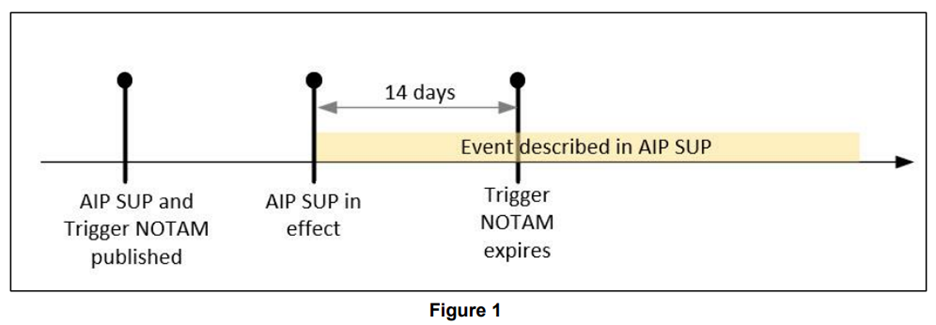
- (2) Trigger NOTAM notify the users of newly published AIP SUP or that updated aeronautical information products will be effective. Trigger NOTAM for AIP SUP are published upon the publication of the AIP SUP and remain in force up to fourteen (14) days from the AIP SUP effective date, after which the Trigger NOTAM self-expires. Trigger NOTAM related to aeronautical information products are published fourteen (14) days before the effective date and remain in force for fourteen (14) days, after which the Trigger NOTAM self-expires.
-
(a) Therefore, personnel involved in flight operations must regularly consult AIP SUP, as there could be no Trigger NOTAM in force at the time of the flight. Refer to Figure 1.
Note: Ensure NOTAM are obtained from a credible source, such as directly from the Air Navigation Service Provider (ANSP) or, if obtained from a third-party source, with evidence that data is received from the ANSP and is up to date.
-
4.2 AIP Supplements (AIP SUP)
- (1) AIP Supplements should be used when the temporary information is of long duration (exceeding three months) or when the information of short duration requires extensive text or is better understood with the use of illustrations.
- (2) During a transition period, to ensure users are accustomed to consult AIP SUP regularly, AIP SUP are used in two (2) contexts. In both cases, a conspicuous statement under the header of the AIP identifies the context:
- (a) Situational Awareness only: means that NOTAM are the primary means of obtaining the information and the AIP SUP provides additional information with longer narratives and portrayal of the situation. Subjects covered by these AIP SUP include significant airport and aerodrome constructions, and airspace events, such as surveillance by drones or GPS jamming exercises.
- (i) In these cases, the date(s) and time(s) advertised in the NOTAM take precedence.
- (c) AIP SUP used instead of a NOTAM: in this case, a NOTAM could be issued before an AIP SUP is created, but once the AIP SUP is published, the NOTAM is cancelled. Subjects covered by these AIP SUP include temporary cranes and other similar temporary obstacles to air navigation.
- (a) Situational Awareness only: means that NOTAM are the primary means of obtaining the information and the AIP SUP provides additional information with longer narratives and portrayal of the situation. Subjects covered by these AIP SUP include significant airport and aerodrome constructions, and airspace events, such as surveillance by drones or GPS jamming exercises.
- (3) AIP Supplements are found on the NAV CANADA website and the inventory is updated every 14 days. AIP SUP found on the NAV CANADA website are valid. In doubt of the accuracy of the information, the originator can be contacted for clarification.
4.3 Aeronautical Information Circulars (AIC)
- (1) An Aeronautical Information Circular (AIC) is a notice containing information that does not qualify for a NOTAM or for inclusion in the AIP, but which relates to flight safety, air navigation, technical, administrative, or legislative matters. AIC can include changes to the location or format of aeronautical information.
- (2) AIC can be in force for longer periods. Typical information found in AIC include long-term forecast of any major change in legislation, trials or announcement in changes in level of service.
- (3) Trigger NOTAM are not published to notify of the publication of AIC.
4.4 CFS Section C – Planning
- (1) Supplemental charts must be consulted as they contain information that cannot be otherwise provided on a VNC, VTA or VTPC due to the nature of the information and the scale. Subjects covered by the charts include: ATF corridors, noise abatement procedures (non-aerodrome specific), military low level tactical flying areas and routes, and other areas representing a hazard for aircrafts.
- (2) Common Frequency Areas (CFA) are shown in this section of the CFS when no VTA is published to cover said area.
4.5 AIP Canada GEN 3.2.8 for VFR Navigation Chart Updates
- (1) VFR Navigation Charts (VNC) are updated on a 1-, 2- or 5-year cycle. Rather than leaving the information in a NOTAM for such a long period of time, this section of the AIP is used to list the amendments to the VFR charts.
- (2) Typical information includes changes to air routes, navaids, obstacles to air navigation, low level tactical areas or permanent blasting areas.
4.6 Foreign Aeronautical Information
- (1) Under International Civil Aviation Organization Annex 15 - Aeronautical Information Services, each member State is responsible for the management of aeronautical data and information over its own territory and areas over the high seas for which it is responsible for the provision of air traffic services.
- (2) An instrument flight procedure, including an ATS route, may incorporate data originating from another State, such as a waypoint or NAVAID. Although such foreign elements are depicted on Canadian charts, the responsibility for managing and maintaining the associated data rests with the originating State, not with Canada. If a foreign entity affects a Canadian procedure, only the procedure can be the object of the NOTAM. As a result, except for St-Pierre and Miquelon (France) and NOTAM issued regarding conflict zone risks in foreign airspace, Canadian NOTAM can only be pertaining to Canadian facilities, instrument flight procedures, services, and airspace.
- (3) Therefore, it is necessary to obtain NOTAM and other aeronautical information from the originating Air Navigation Service Provider (ANSP) to ensure it is complete and up to date.
5.0 Information management
- (1) Not applicable.
6.0 Document history
- (1) Not applicable.
7.0 Contact us
For more information, please contact:
E-mail: TC.FlightStandards-NormesDeVol.TC@tc.gc.ca
We invite suggestions for amendment to this document.
Submit your comments to:
AART Documentation Services
E-mail: AARTDocServices-ServicesdocAART@tc.gc.ca
Original signed by Bernard Champagne for
Jamie-Lee MacDermid
Executive Director, Standards Branch
Civil Aviation
Appendix A — Publication and duration of Trigger NOTAM
Text description
The image, titled "Appendix A — Publication and duration of Trigger NOTAM" consists of a horizontal timeline with an arrow pointing to the right, indicating the passage of time originating from the date of publication of an AIP Supplement and the associated Trigger NOTAM, followed by the date which marks the AIP Supplement coming into effect, and the date marking the expiration of the associated Trigger NOTAM.
The first timeline marker reads “AIP SUP and Trigger NOTAM published” to signify the initial publication of an AIP Supplement and the corresponding Trigger NOTAM used to notify the users of newly published AIP Supplements or that updated aeronautical information products will be effective.
The second timeline marker reads “AIP SUP in effect” to signify the date upon which the AIP Supplement takes effect.
The third timeline marker reads “Trigger NOTAM expires” to signify the date on which the associated Trigger NOTAM self-expires, which takes place fourteen (14) days following the second timeline marker of “AIP SUP in effect” and is depicted by a line connecting the second and third timeline markers with the text “14 days” written above. A yellow line containing the text “Event described in AIP SUP” begins from the second timeline marker depicting the AIP Supplement taking effect and continues past the third timeline marker into the continuous future to represent the ongoing presence of the event described in the AIP Supplement. This aims to show the presence of an active event described in an AIP Supplement even after the associated Trigger NOTAM has expired and no longer exists.