
The report outlines TC’s approach to addressing misconduct and wrongdoing, provides a detailed breakdown of founded cases by category for 2024-2025, includes examples for each category, and summarizes the corrective measures applied in each case.
Aussi disponible en français sous le titre : Rapport annuel sur l'inconduite et les actes répréhensibles
Transport Canada grants permission to copy and/or reproduce the contents of this publication for personal and public non-commercial use. Users must reproduce the materials accurately, identify Transport Canada as the source and not present theirs as an official version, or as having been produced with the help or the endorsement of Transport Canada.
To request permission to reproduce materials from this publication for commercial purposes, please complete the following web form: https://tc.canada.ca/en/corporate-services/application-crown-copyright-clearance Or contact TCcopyright-droitdauteurTC@tc.gc.ca
For more information, contact
Transport Canada
330 Sparks Street
Ottawa ON Canada K1A 0N5
Telephone: 1-866-995-9737 TTY: 1-888-675-6863
Copyright
© His Majesty the King in Right of Canada, as represented by the Minister of Transport, 2025.
Cat. No. T1-40E-PDF (Electronic PDF, English)
Cat. No. T1-40F-PDF (Electronic PDF, French)
TP 15694E
ISSN 2819-8468
Table of contents
- Message from the Deputy Ministers: Our Commitment
- Introduction
- How TC addresses misconduct and wrongdoing
- Founded cases closed in the 2024-25 fiscal year
- Misconduct cases
- Wrongdoing under the PSDPA
- Workplace harassment and violence cases
- Summary descriptions of founded cases and corrective measures
- Your role in advancing integrity
- Conclusion
- Annex A – Guiding framework for workplace behaviours
- Annex B – Definitions
- Annex C – Workplace harassment and violence resolution process
- Annex D – Advancing Values and Ethics at TC
Message from the Deputy Ministers: Our Commitment
Today, we release Transport Canada’s (TC’s) first Annual Report on Misconduct and Wrongdoing in the workplace. This is not a report we take lightly. It speaks to difficult issues that affect real people, and it underscores our obligation as leaders to confront them with clarity, transparency, and resolve.
A safe, respectful, and ethical workplace is not optional. It is the minimum standard that every employee has the right to expect, and it is indispensable to our ability to deliver on TC’s mandate for Canadians. The values in TC’s Values and Ethics Code of Professional Conduct – respect for democracy, respect for people, integrity, stewardship, and excellence – are not abstract principles. They are the foundation for how we must conduct ourselves, and how we must hold one another accountable.
The data and cases described in this report are a reminder that misconduct and wrongdoing, in any form, have no place at TC. Even a single instance is unacceptable. When it occurs, we must – and we do – respond firmly, fairly, and without hesitation. This is our duty: to protect every employee from harm, to uphold the integrity of our institution, and to maintain the trust of the Canadians we serve.
We encourage you to read this report. It demonstrates our commitment to addressing misconduct directly, applying consequences where warranted, supporting those affected, and strengthening the systems that prevent wrongdoing in the first place. Transparency is an essential part of that work.
Our commitment is clear: there is no tolerance for misconduct or wrongdoing at TC. We will continue to confront these issues openly, improve our processes, and ensure that integrity and respect are not only expected, but consistently demonstrated across our organization.
Together, we can and must ensure that TC is a workplace where every individual feels safe, valued, and protected and where our actions reflect the highest standards of public service.
Introduction
This inaugural Annual Report on Misconduct and Wrongdoing provides an account of cases deemed founded – confirmed through investigation or fact-finding – and concluded during fiscal year 2024-25 Footnote 1. The report outlines the nature of these cases, the processes followed to address them, and the measures applied to uphold accountability.
The data for this report was drawn from multiple sources, each with its own collection methods and definitions. These differences created limitations for analysis and made identifying trends challenging. We are actively working to improve consistency and strengthen future reporting.
By publishing this report, TC reinforces its responsibility to act transparently and objectively in managing misconduct and wrongdoing. Future reports will build on this foundation, enabling year-over-year comparisons, trend analysis, and continuous improvement in how we safeguard integrity across the organization.
We welcome your feedback to help strengthen future editions of this report. Please send comments and suggestions to TC.Integrity-integrite.TC@tc.gc.ca.
How TC addresses misconduct and wrongdoing
Any TC employee – including students, casuals, and contractors – who wishes to report actual or perceived misconduct (breaches of rules, policies, or codes of conduct) or wrongdoing Footnote 2 (serious violations as defined under the Public Servants Disclosure Protection Act, or PSDPA) can use the available reporting channels. Reports can be made to a supervisor, management, the Ombuds Office, or the Integrity Office. Complaints related to workplace harassment and violence should be directed to the Centre of Expertise for Workplace Harassment and Violence Prevention and Resolution – TC’s Designated Recipient.
Although the processes used to address suspected instances of misconduct or wrongdoing may vary depending on the nature of the allegations, TC consistently manages such instances in accordance with the policies outlined in its guiding framework for workplace behaviours (Annex A). Throughout, the priority is placed on:
- Ensuring a fair and impartial process for all parties.
- Respecting confidentiality and protecting the privacy of individuals involved.
Steps in the process include:
- An initial review of allegations to determine whether further action is warranted.
- Where warranted, a fair, impartial, and timely fact-finding exercise or formal investigation.
A fact-finding exercise is used when circumstances are relatively clear and do not require an in-depth investigation. A formal investigation is initiated when the situation is more complex and additional information is needed. The decision to investigate considers:
- The nature and scope of the allegation(s).
- Whether the issue is ongoing or historical.
- Whether the allegation is vexatious (lacks merit, repetitive, or intended to harm).
- Potential risks to individuals and the organization.
- The seriousness of the allegation.
Cases are considered founded when, following a review or investigation, the established facts and available evidence demonstrate on a balance of probabilities that misconduct or wrongdoing has likely occurred (meaning that there is a greater than 50 per cent chance that the alleged misconduct or wrongdoing did occur).
Actions taken in founded cases of misconduct and wrongdoing
Once a case is confirmed as founded, TC applies corrective measures to uphold integrity and prevent reoccurrence. These measures generally fall into two categories:
- Administrative measures focus on managing risk and preventing reoccurrence. They often involve adjustments to work arrangements or providing support such as training or coaching.
- Disciplinary measures address inappropriate behaviour and are intended to hold individuals accountable. They typically follow a progressive approach, starting with less severe actions and escalating as necessary based on the nature, frequency, and severity of the misconduct.
In some cases, both types of measures are applied together. This approach is used when the situation requires both accountability and proactive steps to reduce reoccurrence – for example, applying a suspension (disciplinary) while also requiring training or closer oversight (administrative). Combining measures reinforces expectations for ethical conduct and helps ensure the behaviour does not reoccur.
Detailed definitions of these measures and examples are provided in Annex B.
Publication of PSDPA cases
When allegations investigated under the PSDPA are deemed founded, TC publishes a summary of the wrongdoing and actions taken to address it on its webpage, which is kept at a high level to respect confidentiality and to protect personal information.
Founded cases closed in the 2024-25 fiscal year
During the reporting period, a total of 58 cases were deemed founded and closed. Of the 58 founded cases, 43 cases concluded during the fact-finding exercise without the need for an investigation and 15 cases concluded following the conduct of a formal investigation. In addition, there were six cases that were deemed unfounded but to which administrative measures were applied to correct a situation (e.g., training, coaching).
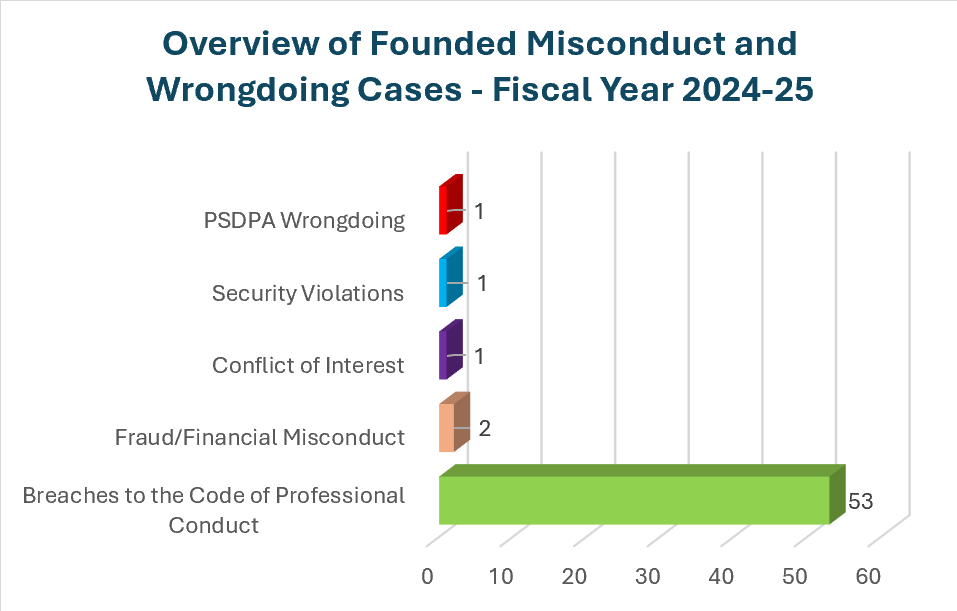
Long Description
Overview of Founded Misconduct and Wrongdoing Cases – Fiscal Year 2024-25
- PSDPA Wrongdoing: 1
- Security Violations: 1
- Conflict of Interest: 1
- Fraud/Financial Misconduct: 2
- Breaches to the Code of Professional Conduct: 53
To respect confidentiality and protect personal information, case descriptions in this report are presented at a high level without identifying details. They are organized into three groupings: misconduct (e.g., breaches of TC’s Values and Ethics Code of Professional Conduct, fraud), wrongdoing under the PSDPA, and workplace harassment and violence. Each grouping includes summaries of the situations addressed during the reporting period and the corrective actions taken to uphold integrity and accountability across TC.
Misconduct cases
Breaches to TC’s Values and Ethics Code of Professional Conduct
Breaches to TC’s Values and Ethics Code of Professional Conduct covers a wide range of conducts that contravene the values and ethics that employees must adhere to and uphold. Examples can include the undue use of influence or unauthorized access to resources, misrepresenting or providing false personal information, and not disclosing a conflict of interest.
There were 53 cases of founded breaches to TC’s Values and Ethics Code of Professional Conduct during 2024-25. One of these cases involved an executive. Of the 53 cases, 50 resulted in either a disciplinary measure (e.g., punitive measures that are typically recorded in the employee’s disciplinary file) or an administrative measure (e.g., non-punitive measures that are meant to support or guide the employee rather than penalize them) being applied. The corrective measures applied ranged from reprimands to termination. For example, in one case, a photo of an employee appearing to behave inappropriately while wearing a TC uniform was posted on social media. The employee received a disciplinary oral reprimand. In another case, an employee made disrespectful comments to a facilitator during a training session and was required to issue an apology (an administrative measure). In a third case where an employee posted a political message using their profile icon on Teams, the employee received a caution letter because of the risk that could be created to the reputation of TC, the Government of Canada, and/or their colleagues.
In three of the 53 cases, both disciplinary and administrative measures were applied. For example, in one case, an employee made inappropriate and disrespectful comments, which resulted in a disciplinary suspension followed by mandatory training (an administrative measure).
Fraud/financial misconduct
Fraud or financial misconduct refers to wrongful or criminal deception intended to result in financial or personal gain. This may include but is not limited to misuse, embezzlement or theft of government property or funds; contract or procurement fraud; contractor misconduct; and mismanagement or misappropriation of funds.
There were two cases related to fraud or financial misconduct during the reporting period. In one case, theft was identified. The respondent was suspended and required to complete mandatory training. In the other case, an employee conducted personal business during work hours and used TC transportation to travel to the location where the business activity occurred. In this case, the respondent resigned before disciplinary measures could be applied but the department was able to recover the funds (reimbursement for the time theft) during FY 2024-25.
Conflict of interest
Conflict of interest occurs when private interests, arrangements, or relationships are in conflict, or could influence, or be perceived to influence, official duties, decision-making, or recommendations. Employees are expected to avoid real, apparent or potential conflict of interest situations.
One case involved a conflict of interest. The employee did not disclose that they were a co-owner of a company with their spouse – a company that had held contracts with TC, which ended in 2012. The employee should have declared this conflict; however, they did not work in the area of the department where the company provided services, and there was no evidence that they directly helped the company obtain this work. As a result, no disciplinary action was taken, but the employee was directed to update their Declaration of Conflict of Interest to ensure compliance going forward.
Personnel security violations
Personnel security violations encompass a range of breaches that compromise the integrity and safety of classified information and national interests. These include information security breaches (such as the improper transmission, transportation, or unauthorized access to classified materials), national security breaches (involving conduct that raises concerns about an individual’s loyalty to Canada or alignment with national values), insider threats (including unauthorized dissemination of sensitive information, acts of espionage, or other malicious activities from within the organization), reliability-related breaches (where an individual's trustworthiness or suitability for access to sensitive information is called into question), and other security breaches that do not fall under the jurisdiction of specific departmental investigative units but still pose a risk to personnel or organizational security.
One case involved personnel security violations and concluded with the respondent’s termination. The employee had been working abroad without obtaining the necessary authorization and approval.
Wrongdoing under the PSDPA
There was one case of wrongdoing under the PSDPA section 8 (c), which refers to gross mismanagement in the public sector. In this case, a manager’s authoritarian and controlling behaviours created a toxic work environment where the employees felt disrespected and micro-managed. This person’s behaviour directly impacted morale and the decision of two-thirds of the employees to leave the team. A letter of expectations outlining the values and behaviours expected for the position was issued. This person also underwent external coaching to improve managerial skills, and senior management monitored their development in terms of the expectations related to the position, management skills and team relations.
The published findings for this case can be found on TC’s Findings and Management Action Plan webpage.
Workplace harassment and violence cases
Harassment and violence include any action, conduct, or comment – sexual or otherwise – that could reasonably cause offence, humiliation, or physical or psychological harm to an employee.
Occurrences can be reported to TC’s Designated Recipient at the Centre of Expertise for Workplace Harassment and Violence Prevention and Resolution, either verbally or in writing through a Notice of Occurrence. The resolution process involves steps such as initial review, negotiated resolution, conciliation, and, if required, investigation. Full details of this process are provided in Annex C.
Of note, the goal of the resolution process is to understand and address factors that may contribute to harassment and violence in the workplace. It focuses on identifying risks and making improvements – not on assigning blame or imposing discipline.
Over the reporting period, 33 notices of occurrence were provided to TC’s Designated Recipient. At the time of this report, none had been determined to meet the definition of workplace harassment and violence within the meaning of the Canada Labour Code Part II, Occupational Health and Safety.
Of the 33 notices of occurrence:
- Twelve were resolved through initial review, five through negotiated resolution and one through investigation (did not meet the definition of workplace harassment and violence);
- Three cases were actively being investigated at the time of the preparation of this report; and
-
Twelve cases were actively engaged in negotiated resolution.
Summary descriptions of founded cases and corrective measures
The following table presents a breakdown of the themes in the founded cases, as well as the corrective measures applied. In some cases, more than one corrective measure was applied.
|
Type of misconduct or wrongdoing |
Number of founded cases |
Corrective measures applied Footnote 3 |
|---|---|---|
|
Breaches to TC’s Values and Ethics Code of Professional Conduct |
53 |
|
|
Fraud/financial misconduct |
2 |
|
|
Conflict of interest |
1 |
|
|
Personnel security violations |
1 |
|
|
Wrongdoing under the Public Servants Disclosure Protection Act |
1 |
|
Your role in advancing integrity
Every employee plays a vital role in sustaining a culture of trust and respect. We encourage you to:
- Know the code: familiarize yourself with the TC Values and Ethics Code of Professional Conduct.
- Speak up: if you wish to report a concern or seek guidance, don’t hesitate to reach out to any of the offices listed below – your voice matters. We follow a “no wrong door” approach, so even if your issue doesn’t fall within the mandate of the office you contact initially, you’ll be redirected to the right place.
- Centre of Expertise for Workplace Harassment and Violence Prevention and Resolution: HVPDesignatedRecipient-DestinataireDesignePHV@tc.gc.ca
- Integrity Office: tc.integrity-integrite.tc@tc.gc.ca
- Ombuds: tc.ombudsoffice-bureauombuds.tc@tc.gc.ca
- Scientific Integrity Lead: chantal.roy@tc.gc.ca
- Values and Ethics Office: valuesethics-valuesethics@tc.gc.ca
- Lead by example: model ethical behaviour in your daily decisions and interactions.
- Stay informed: participate in training and discussions to strengthen your understanding of values and ethics.
Together, we can ensure TC remains a workplace where integrity is at the core of everything we do.
Conclusion
The first Annual Report on Misconduct and Wrongdoing at TC marks a significant step in strengthening our department’s commitment to accountability and transparency. It provides a clear overview of how we are managing and responding to cases of misconduct and wrongdoing, and where we currently stand as an organization.
This report is one of several tools we are using to promote openness and reinforce the values that guide our work (see Annex D for the other initiatives we have implemented to advance values and ethics). By sharing this information, we aim to foster a culture of respect, integrity, and excellence across TC.
Thank you for your continued commitment to upholding the values that define TC.
Annex A – Guiding framework for workplace behaviours
|
Treasury Board Secretariat (TBS) Values and Ethics Code for the Public Sector and TC’s Values and Ethics Code of Professional Conduct |
The two codes outline the principles and expected ethical behaviours for employees. They set clear expectations for work behaviours and ethical decision making, helping employees to understand and do what is right. They promote accountability and strengthen the culture of responsibility, integrity and effective governance. The codes also set the standard for a safe, inclusive, fair and ethical work environment where employees can expect to be treated in accordance with these values by our colleagues and management. |
| TBS Directive on Conflict of Interest | This directive provides direction to employees and designated senior officials to enable them to minimize risks associated with conflict of interest and conflict of duties situations with the goal of upholding the values and ethics of the public sector and the public interest. |
| TBS Policy on Service and Digital | This policy and supporting instruments serve as an integrated set of rules that articulate how Government of Canada organizations manage service delivery, information and data, information technology, and cyber security in the digital era. |
| TC Workplace Harassment and Violence Prevention and Resolution Policy | Under the Canada Labour Code, Part II, Occupational Health and Safety, federally regulated employers must protect the health and safety of persons employed in their organizations. As such, TC’s Workplace Harassment and Violence Prevention and Resolution Policy has been jointly developed with the National Policy Health and Safety Committee, in accordance with the Workplace Harassment and Violence Prevention Regulations and the Treasury Board Directive on the Prevention and Resolution of Workplace Harassment and Violence. This policy aims to prevent workplace harassment and violence, including sexual harassment and sexual violence. It also includes information to help the department respond to situations in which harassment and violence have occurred, and to support all persons affected by workplace harassment and violence. The policy extends to cases of domestic violence which can overtly enter the workplace through disruptive phone calls, harassing emails, inappropriate visits on site, threats of harm to the co-workers of the person employed, or physical violence. |
| TC Policy on Scientific Integrity | This policy recognizes the right to freedom of expression by researchers and scientists on matters of research or science, as well as the important role of researchers and scientists in communicating research and scientific information to the public. The policy supports a culture of scientific integrity and the broad sharing of research results to foster open, transparent and evidence-based decision-making. |
| TC Fraud and Misconduct Policy (currently being reviewed) | The policy aims to facilitate the development of controls that aid in the detection and prevention of fraud and misconduct against TC. The expected results of this policy are that the risk of fraud or misconduct being perpetrated against the department is mitigated. |
| Public Servants Disclosure Protection Act (PSDPA) | The act upholds integrity and accountability within the federal public service by providing a secure and confidential mechanism for employees to report serious wrongdoing. It also provides a mechanism to protect those who come forward from reprisals. |
| TBS Policy on People Management and Guidelines for Discipline |
This policy aims to establish a cohesive and strategic framework that supports the effective management of human resources across the federal public service. It also aims to foster a high-performing, inclusive, and respectful workforce by promoting core public service values. It uses a progressive discipline approach that emphasizes early intervention, clear communication, and fair, consistent application of corrective measures to address employee misconduct or performance issues, with the goal of fostering improvement rather than imposing punishment. |
Annex B – Definitions
This section provides definitions of some key concepts central to this report.
- Administrative measures help manage or prevent reoccurrence and can include placing an employee on leave without pay for unauthorized absences, documenting behaviour in performance evaluations, or temporarily revoking delegation authorities. They may also involve supportive actions such as training, coaching, or regular check-ins with management.
- Disciplinary measures address inappropriate behaviour and range from oral or written reprimands to suspension, financial penalties, demotion, or termination. While disciplinary action typically follows a progressive model, serious misconduct may warrant significant measures even for a first offence.
- Founded cases refer to cases where, based on the balance of probability, the evidence supports the conclusion that misconduct or wrongdoing likely occurred. This means there’s a greater than 50 per cent chance that the alleged misconduct or wrongdoing did occur.
- Misconduct is defined as any action whereby an individual willfully contravenes an act, a regulation, a rule, a departmental or Treasury Board policy instrument, an approved procedure, a departmental code of conduct, a reasonable and lawful management request, and/or the Values and Ethics Code for the Public Service. In short, when an employee contravenes any of the obligations they agree to abide by when becoming an employee of the department.
- Wrongdoing, as per the PSDPA, is:
- (a) a contravention of any Act of Parliament or of the legislature of a province, or of any regulations made under any such Act, other than a contravention of section 19 of this Act Footnote 5;
- (b) a misuse of public funds or a public asset;
- (c) a gross mismanagement in the public sector;
- (d) an act or omission that creates a substantial and specific danger to the life, health or safety of persons, or to the environment, other than a danger that is inherent in the performance of the duties or functions of a public servant;
- (e) a serious breach of a code of conduct established under section 5 (public sector) or 6 (departmental);
- (f) knowingly directing or counselling a person to commit a wrongdoing set out in any of paragraphs (a) to (e).
Annex C – Workplace harassment and violence resolution process
Under the Canada Labour Code Part II, Occupational Health and Safety, workplace harassment and violence include any action, conduct, or comment – sexual or otherwise – that could reasonably cause offence, humiliation, or physical or psychological harm to an employee. The steps involved in reporting and resolving such occurrences are outlined below.
Step 1: Reporting
Occurrences can be reported to TC’s Designated Recipient at the Centre of Expertise for Workplace Harassment and Violence Prevention and Resolution, either verbally or in writing through a Notice of Occurrence.
Step 2: Resolution Process
The resolution process consists of four phases:
- Initial Review
The Designated Recipient reviews the notice of occurrence to ensure all necessary information is provided. If the principal party (the person affected) cannot be identified, the process ends at this stage. - Negotiated Resolution
Within 45 days of receiving a notice of occurrence, the Designated Recipient engages with the principal party to review the occurrence(s) and facilitate discussions with the principal party, the responsible manager, and the responding party (the person alleged to be responsible for the occurrence) to clarify information and explore resolution options. - Conciliation
A voluntary and confidential process in which a neutral third party works with the principal and responding parties to facilitate discussions and support efforts to resolve the occurrence(s). - Investigation
May be requested by the principal party or the Designated Recipient. The investigator reviews all available information and meets with the principal party, the responding party, and any witnesses to determine whether the situation meets the definition of workplace harassment and violence. If it does, the investigator identifies root causes and recommends measures to prevent reoccurrence.
Step 3: Completion of the Process
The resolution process is considered complete when:
- The principal party chooses to end the process.
- The principal party and the Designated Recipient agree that the event does not meet the definition of workplace harassment and violence.
- The occurrence is resolved through negotiated resolution or conciliation.
- A recommendation in an investigator’s report has been implemented.
- The employer and TC’s workplace committee or health and safety representative have completed a mandatory review and, if necessary, updated the workplace risk assessment.
Note: The goal of the resolution process is to understand and address factors that may contribute to harassment and violence in the workplace. It focuses on identifying risks and making improvements – not on assigning blame or imposing discipline.
Annex D – Advancing Values and Ethics at TC
TC continues to strengthen its foundation of integrity, accountability, and respect – principles that define who we are and how we work. Over the past year, we have taken significant steps to embed these values into every aspect of our operations, ensuring that ethical behaviour is not just expected, but actively supported and reinforced.
Our commitment goes beyond compliance; it is about fostering a culture where employees feel safe, respected, and empowered to speak up. These efforts reflect a shared responsibility to uphold public trust and create a workplace where integrity drives decision-making and collaboration.
Key Initiatives
Independent review of values, ethics, and integrity system
An independent review launched in FY 2023-24, including employee consultations, identified areas for improvement such as clearer communication, defined roles and responsibilities, and better measurement and reporting of misconduct and wrongdoing. In response, TC developed a communications and engagement strategy, a performance measurement and reporting strategy, and introduced this Annual Report to promote transparency and accountability.
Establishment of the Ombuds Office
The creation of an independent Ombuds Office marks a milestone in supporting employee well-being. Reporting directly to the Deputy Minister, this office provides a confidential, impartial space for employees and ensures systemic issues are addressed at the highest level.
Updated the Code of Values and Ethics
Our revised TC Values and Ethics Code of Professional Conduct sets clear expectations for ethical behaviour and reinforces our commitment to a safe, inclusive, and respectful workplace.
Embedding accountability
Accountability is now integrated into executive performance reviews and mandatory objectives for all employees, reinforcing that respect, diversity, and inclusion are core to how we work.
Strengthened conflict of interest (COI) management
A new mandatory self-declaration process and national approach to COI assessments ensure consistency and transparency, supported by tools and team discussions that promote awareness and proactive risk management.
Workplace risk assessment
By identifying psychosocial risk factors such as organizational culture and leadership clarity, we are taking targeted action to prevent harassment and violence and foster a healthier work environment.
Advancing learning and awareness
Through mandatory training, discussion series, and specialized courses, we continue to build capacity and awareness, ensuring employees have the tools to uphold integrity in all areas of work.
Together, these initiatives demonstrate TC’s unwavering commitment to values and ethics – not as a set of policies, but as a living framework that shapes our culture and strengthens public trust. By embedding integrity into everything we do, we are building a workplace where respect, accountability, and ethical leadership thrive.

Annual report on misconduct and wrongdoing
(PDF, 666 KB)