
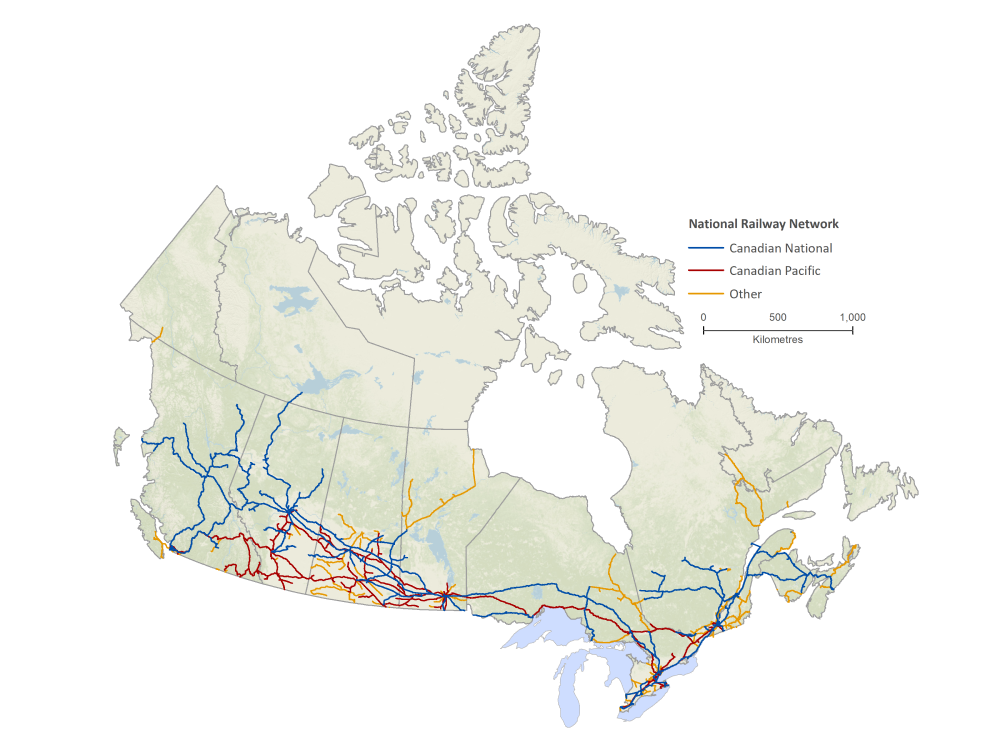
Image description - Rail Transportation Network
The map of Canada shows the layout and extent of the Canadian rail system. This system currently has over 43,000 route-kilometres of track broken down into Canadian National track (50.8 per cent of the system, represented by blue lines), Canadian Pacific track (30.4 per cent, represented by red lines) and other railways track (18.8 per cent, represented by orange lines).
Rail operations serve nearly every part of the Canadian economy, including manufacturing, agricultural, natural resource, wholesale and retail sectors, and tourism industry. Canada has an extended railway system used to transport mainly freight to and from the US, and international markets via coastal ports, as well as passengers across Canada.
Freight sector
The freight rail transportation sector specializes in moving heavy, bulk commodities and containerized traffic over long distances.
Canada has 2 major Class I freight railways, CN and CP, which are responsible for most freight rail traffic. Large US-based carriers also operate in Canada. Examples include the Burlington Northern Santa Fe Railway Company and CSX Transportation Inc.
Together, CN, CP and Burlington Northern Santa Fe Railway Company provide strategic links in the trade route between Canada, the US and Mexico. BNSF’s service to Canada’s Pacific Gateway gives Vancouver the unique advantage of being the only port on the North American West Coast served by 3 Class I railroads.
In terms of equipment, Class I railway carriers had 2,399 locomotives in 2019, with 53,970 freight cars, mainly hopper cars, boxcars, flatcars and gondolas, and 451 passenger cars.
There are 70 companies that fall under the authority of the Railway Safety Act. 25 of these companies are federal railway companies, who must also hold a certificate of fitness from the Canadian Transportation Agency. Additionally, there are multiple federally or provincially regulated shortline railways that typically connect shippers of products with Class I railways or to other shortlines and ports in order to move products across longer distances. Shortline railways transport $34.4 billion worth of freight on average to and from continental rail networks, such as CN and CP, and to ports and terminals.
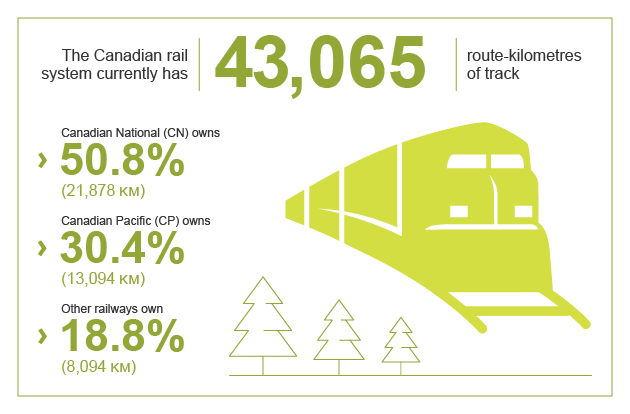
Image description - Rail Transportation infographic
The Canadian rail system currently has 43,065 route-kilometres of track
- Canadian National (CN) owns 50.8% (21,878 km)
- Canadian Pacific (CP) owns 30.4% (13,094 km)
- Other railways own 18.8% (8,094 km)
Passenger sector
The passenger rail sector provides commuter, intercity and tourist transportation services. National rail passenger services are largely provided by VIA Rail on behalf of the Government of Canada. VIA Rail is an independent Crown corporation created in 1977, operating Canada’s national passenger rail service from coast to coast. It operates mainly over shared infrastructure owned by freight rail companies.
Most of its services are in central Canada along the Quebec-Windsor Corridor. VIA Rail also operates long-haul passenger routes between Toronto and Vancouver and Montreal and Halifax, as well as regional services to destinations such as Jasper, Prince Rupert, Winnipeg and Churchill. In 2020, VIA Rail operated 202 train departures weekly on a 12,500 km network.
In addition to shortlines focused on moving freight, other shortlines provide passenger rail services or tourism services, such as the Rocky Mountaineer Railway.