
This bulletin explains the requirements for transporting batteries. It does not change, create, amend or suggest deviations to the Transportation of Dangerous Goods Regulations (TDG Regulations).
On this page
- Classification
- Shipping document
- Dangerous goods marks
- Means of containment
- Training
- Special cases
- Special provisions
- Compliance with the TDG Act and Regulations
- Contact us
Classification
Definition of a battery
Since the term “battery” is not defined in the TDG Regulations, we must rely on the dictionary definition. The Collins dictionary defines a battery as a device that provides the power for electrical items, such as cells or batteries.
Difference between a cell and a battery
A cell is a single encased electrochemical unit (one positive and one negative electrode) with a voltage differential across its two terminals, such as AA and AAA batteries.
A battery consists of two or more cells connected electrically and equipped with features that include casings, terminals, markings, and protective devices to ensure they work properly, such as cordless phone batteries, etc.
Importance of classifying batteries properly
Some batteries are regulated as dangerous goods because they may pose hazards during transport. These hazards include:
- short circuits, which can lead to fires
- leaks of corrosive liquid or other material that can injure people or harm the environment
Responsibility for classifying batteries
The consignor is responsible for classifying dangerous goods (batteries in this case) in accordance with Part 2 of the TDG Regulations.
Batteries are typically classified as Class 8, Corrosives or Class 9, Miscellaneous Products, Substances or Organisms, though some may be considered Class 4.3, Water Reactive Substances.
In Canada, the shipping and importing of lithium batteries is subject to the Transportation of Dangerous Goods Act, 1992 (TDG Act) and the TDG Regulations. They are considered dangerous goods much like gasoline, propane and sulfuric acid.
Use of lithium batteries
Lithium batteries are used in a wide range of electronic devices such as cameras, cell phones, laptop computers, watches, medical equipment, power tools, etc.

Possible shipping names for batteries
| UN # | Shipping name and description | Class |
|---|---|---|
| UN2794 | BATTERIES, WET, FILLED WITH ACID, electric storage | 8 |
| UN2795 | BATTERIES, WET, FILLED WITH ALKALI, electric storage | 8 |
| UN2800 | BATTERIES, WET, NON-SPILLABLE, electric storage | 8 |
| UN3028 | BATTERIES, DRY, CONTAINING POTASSIUM HYDROXIDE SOLID, electric storage | 8 |
| UN3090 | LITHIUM METAL BATTERIES (including lithium alloy batteries) | 9 |
| UN3091 |
LITHIUM METAL BATTERIES CONTAINED IN EQUIPMENT (including lithium alloy batteries) or LITHIUM METAL BATTERIES PACKED WITH EQUIPMENT (including lithium alloy batteries) |
9 |
| UN3292 |
BATTERIES, CONTAINING SODIUM or CELLS, CONTAINING SODIUM |
4.3 |
| UN3480 | LITHIUM ION BATTERIES (including lithium ion polymer batteries) | 9 |
| UN3481 |
LITHIUM ION BATTERIES CONTAINED IN EQUIPMENT (including lithium ion polymer batteries) or LITHIUM ION BATTERIES PACKED WITH EQUIPMENT (including lithium ion polymer batteries) |
9 |
Difference between a “lithium metal battery” and a “lithium ion battery”
Lithium metal batteries are usually non-rechargeable, contain metallic lithium, and have a higher energy density than other non-rechargeable batteries. Among other things, they are often used in calculators, pacemakers, remote car locks, and watches.
Lithium ion batteries are rechargeable, do not contain metallic lithium, and have a high energy density. Lithium polymer batteries are considered a type of lithium ion battery. Lithium ion batteries are used in consumer goods such as cell phones, electric vehicles, laptop computers, power tools, drones, etc.
Difference between “contained in equipment” and “packed with equipment”
A lithium ion or lithium metal battery contained in equipment means a battery that is embedded in the device, such as calculators, laptop computers, or watches.
A lithium ion or lithium metal battery packed with equipment is not embedded in the device, such as a power tool packed alongside a spare battery.
Shipping document
Requirement for a shipping document when transporting batteries
Unless exempt from the TDG Regulations through a special case, special provision or equivalency certificate, battery shipments must fully comply with the TDG Regulations.
When shipping batteries by marine or air transport, consult Parts 11 and 12 of the TDG Regulations as well as the following documents:
- the International Civil Aviation Organization’s Technical Instructions for the Safe Transport of Dangerous Goods by Air (ICAO Technical Instructions)
- the International Maritime Organization’s International Maritime Dangerous Goods Code (IMDG Code)
Note: Other information may be required depending on the mode of transport. For more information on shipping documents, consult Part 3 of the TDG Regulations and the following Shipping document webpage.
Dangerous goods marks
Under the TDG Regulations, dangerous goods marks do not have to be displayed directly on batteries because they are considered dangerous goods and not means of containment. Part 4 of the TDG Regulations requires that dangerous goods marks be displayed on the means of containment containing dangerous goods in transport.
Scenarios
Labels and/or placards required when a truck transports batteries in small means of containment
On small means of containment
Since the batteries are in small means of containment, the labelling requirements of Part 4 of the TDG Regulations apply.
Therefore, each small means of containment must display:
- the primary class label
- the shipping name
- the UN number
On truck
As per Section 4.15 of the TDG Regulations, the primary class placard for every dangerous good transported in a large means of containment must be displayed on each side and at each end of the large means of containment, such as a truck.
Note: The TDG Regulations allow an exemption to placarding requirements if the gross mass of dangerous goods in a road or railway vehicle is 500 kg or less. However, placards may still be voluntarily displayed. For more details, consult Sections 4.16.1 and 4.1.1 of the TDG Regulations.
Labels and/or placards required when a truck transports batteries that are placed directly on a pallet (total capacity 450 litres or less) and secured by shrink wrap
On batteries
The batteries do not need labels since the TDG Regulations require them only on small means of containment and batteries are not considered a means of containment.
On pallet
In this situation, the pallet is considered a small means of containment.
Therefore, the small means of containment, which is the pallet and the shrink wrap securing the batteries, must display:
- the primary class label
- the shipping name
- the UN number
Note: This shipment does not qualify as an overpack as defined in Section 1.4 of the TDG Regulations, since the batteries are placed directly on the pallet rather than in separate small means of containment. If this pallet is the only small means of containment transported, the shipping document will display “1” in the column indicating the number of small means of containment on which labels are displayed.
On truck
Under Section 4.15 of the TDG Regulations, the primary class placard for every dangerous good transported in a large means of containment must be displayed on each side and at each end of the large means of containment, such as a truck.
Note: The TDG Regulations allow an exemption to placarding requirements if the gross mass of dangerous goods in a road or railway vehicle is 500 kg or less. However, placards may still be voluntarily displayed. For more details, consult Sections 4.16.1 and 4.1.1 of the TDG Regulations.
Labels and/or placards required when a truck transports batteries that are placed in small means of containment and then placed on a pallet (total capacity 450 litres or less) and secured by shrink wrap
On small means of containment
Since the batteries are in small means of containment, the labelling requirements of Part 4 of the TDG Regulations apply.
Therefore, if the dangerous goods marks for each class of dangerous goods inside the overpack are not visible through the overpack, the pallet with the shrink wrap securing the batteries must display:
- the primary class label
- the shipping name
- the UN number
On pallet
In this case, the pallet containing the batteries may be considered an overpack as defined in Section 1.4 of the TDG Regulations, which states: “means an enclosure that is used by a single consignor to consolidate one or more small means of containment for ease of handling but that is not a minimum required means of containment. This definition does not include a large means of containment or a unit load device, as defined in the ICAO Technical Instructions, that is intended for transport by aircraft”.
Therefore, if the dangerous goods marks for each class of dangerous goods inside the overpack are not visible through the overpack, the pallet with the shrink wrap securing the batteries must display:
- the word “overpack”
- the primary class label
- the shipping name
- the UN number
On truck
As per Section 4.15 of the TDG Regulations, the primary class placard for every dangerous good transported in a large means of containment must be displayed on each side and at each end of the large means of containment, such as a truck.
Note: The TDG Regulations allow an exemption to placarding requirements if the gross mass of dangerous goods in a road or railway vehicle is 500 kg or less. However, placards may still be voluntarily displayed. For more details, consult Sections 4.16.1 and 4.1.1 of the TDG Regulations.
Labels and/or placards required when a truck transports batteries on a pallet (total capacity greater than 450 litres) and secured by shrink wrap
On batteries
Since the TDG Regulations does not have a standard for large means of containment, the transport of batteries on pallets with a capacity of over 450 litres requires an equivalency certificate. The requirements for displaying dangerous goods marks will be included in the equivalency certificate.
To learn how to apply for an equivalency certificate, please visit the How to apply for an equivalency certificate webpage or consult Part 14 of the TDG Regulations.
Labels and/or placards when a truck transports batteries that are not in means of containment
Transporting batteries that are not in means of containment but are on shelves permanently fixed and secured to the truck, an equivalency certificate is required. The requirements for the dangerous goods marks will be identified in the equivalency certificate.
Dangerous goods marks required for batteries shipped by marine transport
To learn about dangerous goods marks requirements for batteries transported by vessel, please consult Part 11 of the TDG Regulations.
Dangerous goods marks required for batteries transported by air
Domestic transport
To ship batteries within Canada by air, Part 12 of the TDG Regulations offers these two options:
- comply with the most recent version of the ICAO Technical Instructions and meet additional requirements under the TDG Regulations
- meet requirements under Sections 12.4 to 12.17 of the TDG Regulations for certain types and quantities of dangerous goods
International transport
To ship or import batteries internationally by air, Part 12 of the TDG Regulations requires that you comply with the ICAO Technical Instructions and additional requirements under the TDG Regulations.
To learn about dangerous goods marks requirements for batteries transported by air, please consult Part 12 of the TDG Regulations.
Means of containment
Standard to be used to transport batteries in small means of containment by road or rail
When batteries (Classes 4, 8 or 9) are transported in small means of containment, Section 5.12 of the TDG Regulations indicates that we must be in compliance with Transport Canada’s standard TP 14850. The table below provides the packing instructions for batteries transported in small means of containment.
| UN# | Shipping name and description | Class | Packing instructions TP 14850 |
|---|---|---|---|
| UN2794 | BATTERIES, WET, FILLED WITH ACID, electric storage |
8 |
801 |
| UN2795 | BATTERIES, WET, FILLED WITH ALKALI, electric storage |
8 |
801 |
| UN2800 | BATTERIES, WET, NON-SPILLABLE, electric storage |
8 |
5 |
| UN3028 | BATTERIES, DRY, CONTAINING POTASSIUM HYDROXIDE SOLID, electric storage |
8 |
801 |
| UN3090 | LITHIUM METAL BATTERIES (including lithium alloy batteries) |
9 |
903 |
| UN3091 |
LITHIUM METAL BATTERIES CONTAINED IN EQUIPMENT (including lithium alloy batteries) or LITHIUM METAL BATTERIES PACKED WITH EQUIPMENT (including lithium alloy batteries) |
9 |
903 |
| UN3292 |
BATTERIES, CONTAINING SODIUM or CELLS, CONTAINING SODIUM |
4.3 |
500 |
| UN3480 | LITHIUM ION BATTERIES (including lithium ion polymer batteries) |
9 |
903 |
| UN3481 |
LITHIUM ION BATTERIES CONTAINED IN EQUIPMENT (including lithium ion polymer batteries) or LITHIUM ION BATTERIES PACKED WITH EQUIPMENT (including lithium ion polymer batteries) |
9 |
903 |
Transportation of batteries in large means of containment by road or rail
To transport batteries in a non-standardized means of containment, in compliance with CGSB-43.145, you must apply for an equivalency certificate delivered by Transport Canada.
To learn how to apply for an equivalency certificate, please visit the How to apply for an equivalency certificate webpage or consult Part 14 of the TDG Regulations.
Training
Part 6 of the TDG Regulations requires that a person who handles, offers for transport or transports dangerous goods, be adequately trained and hold a valid training certificate. However, a person who does not have proper training or hold a valid training certificate may perform these activities in the presence and under direct supervision of a person who is properly trained and holds a valid training certificate.
Note: A special case (Part 1 of the TDG Regulations) or a special provision (Schedule 2 of the TDG Regulations) may exempt you from these training requirements.
To learn about training requirements, please consult TDG Training webpage.
Special cases
Special cases are situations partly or fully exempt from the TDG Regulations. These special cases are found in Sections 1.15 to 1.50 of the Regulations.
Section 1.15 (150 kg Gross Mass Exemption) and Section 1.16 (500 kg Gross Mass Exemption) could apply to the transport of batteries. The two sections limit the gross mass of batteries to 150 or 500 kg respectively and require them to be transported in one or more means of containment, each with a gross mass of 30 kg or less.
As such, these exemptions apply only to the transport of batteries in means of containment with a gross mass of less than 30 kg. If batteries are transported on pallets, the pallets are considered the means of containment. Therefore, the calculation of the gross mass takes the pallet’s mass into account.
To learn more, please consult Sections 1.15 to 1.50 of the TDG Regulations.
Special provisions
| UN # | Shipping name and description | Special provisions (Schedule 2) |
|---|---|---|
| UN2794 | BATTERIES, WET, FILLED WITH ACID, electric storage |
None |
| UN2795 | BATTERIES, WET, FILLED WITH ALKALI, electric storage |
None |
| UN2800 | BATTERIES, WET, NON-SPILLABLE, electric storage |
39 |
| UN3028 | BATTERIES, DRY, CONTAINING POTASSIUM HYDROXIDE SOLID, electric storage |
111 |
| UN3090 | LITHIUM METAL BATTERIES (including lithium alloy batteries) |
34, 123, 137, 138, 149, 159 |
| UN3091 |
LITHIUM METAL BATTERIES CONTAINED IN EQUIPMENT (including lithium alloy batteries) or LITHIUM METAL BATTERIES PACKED WITH EQUIPMENT (including lithium alloy batteries) |
34, 123, 137, 138, 159 |
| UN3292 |
BATTERIES, CONTAINING SODIUM or CELLS, CONTAINING SODIUM |
None |
| UN3480 | LITHIUM ION BATTERIES (including lithium ion polymer batteries) |
34, 123, 137, 138, 149,159 |
| UN3481 |
LITHIUM ION BATTERIES CONTAINED IN EQUIPMENT (including lithium ion polymer batteries) or LITHIUM ION BATTERIES PACKED WITH EQUIPMENT (including lithium ion polymer batteries) |
34, 123, 137, 138, 159 |
Requirements of special provision 34
Special provision 34 exempts a person from the TDG Regulations (except for Parts 1 and 2) if lithium cells or batteries are handled, offered for transport or transported on a road vehicle, railway vehicle or vessel on a domestic voyage and if certain conditions are met.
If each cell and battery type has not passed all the tests in subsection 2.43.1(2) of Part 2 of the TDG Regulations then an exemption cannot be used.
If each cell and battery type passed all the tests in subsection 2.43.1(2) of Part 2 of the TDG Regulations, then see below for additional information.
Exemption conditions for lithium ion cells or lithium ion batteries
Cells (maximum watt-hour rating): 20 Wh maximum
Note: Except for cells manufactured before January 1, 2009, the watt-hour rating must be displayed on the outside case.
Batteries (maximum watt-hour rating): 100 Wh maximum
Total gross mass of cells and batteries: 30 kg maximum by means of containment (except when installed in or packed with equipment).
Dangerous goods marks to display on the means of containment* : The appropriate lithium battery mark in accordance with Section 4.24 of the TDG Regulations.
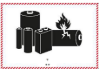
*Does not apply to means of containment containing button cell batteries installed in equipment, including circuit boards, or no more than four cells installed in equipment or no more than two batteries installed in equipment.
Exemption conditions for lithium metal or lithium alloy cells or lithium metal or alloy batteries
Cells (maximum aggregate lithium content): 1g maximum
Batteries (maximum aggregate lithium content): 2g maximum
Total gross mass of cells and batteries: 30 kg maximum by means of containment (except when installed in or packed with equipment).
Dangerous goods marks to display on the means of containment**: The appropriate lithium battery mark in accordance with Section 4.24 of the TDG Regulations.
**Does not apply to means of containment containing button cell batteries installed in equipment, including circuit boards, or no more than four cells installed in equipment or no more than two batteries installed in equipment.
Other requirements
In addition to the requirements above, the special provision requires that cells and batteries be:
- protected against short circuit, including protection against contact with conductive materials within the same packaging that could lead to a short circuit
- packed in a means of containment that completely encloses them
- packed in a means of containment capable of withstanding a 1.2 m drop test in any orientation without damage to the cells or batteries contained inside the means of containment, without the contents shifting so as to allow battery-to-battery or cell-to-cell contact, and without release of contents
In addition to the requirements above, cells and batteries installed in equipment must be (unless the equipment containing them offers equal protection):
- protected against damage and short circuit, including protection against contact with conductive materials within the same packaging that could lead to a short circuit
- placed in a way that prevents accidental activation
- this requirement does not apply to cells and batteries installed in devices that are intentionally active during transport, such as radio frequency identification transmitters, watches and sensors, and that are not capable of generating a dangerous evolution of heat
- packed in a means of containment designed, constructed, filled, closed, secured and maintained so that under normal conditions of transport, including handling, there will be no release of the dangerous goods that could endanger public safety
Exemption that applies for UN2800, BATTERIES, WET, NON-SPILLABLE, not intended for disposal
Special provision 39 states that the TDG Regulations (except for Parts 1 and 2) do not apply to these dangerous goods if:
- at a temperature of 55°C, electrolyte will not flow from a ruptured or cracked battery case and there is no free liquid to flow
- when the battery is prepared for transport, its terminals are protected from short circuits
Transport requirements for damaged or defective lithium metal/ion cells and batteries
Special provision 137 of the TDG Regulations states that damaged or defective lithium metal/ion cells and batteries must be packed in accordance with Packing Instructions P908 or LP904 of the UN Recommendations, as applicable.
The outer means of containment or the overpack must be marked legibly and visibly on a contrasting background with the words “Damaged/Defective Lithium Ion Batteries” or “piles au lithium ionique endommagées/défectueuses” or “Damaged/Defective Lithium Metal Batteries” or “piles au lithium métal endommagées/défectueuses”, as applicable.
Note:
- it is forbidden to transport lithium ion cells or batteries and lithium metal cells or batteries that are damaged or defective and that, under normal conditions of transport, are liable to disassemble rapidly, react dangerously, produce a flame or a dangerous evolution of heat, or produce a dangerous emission of toxic, corrosive or flammable gases or vapours
- it is forbidden to transport by aircraft lithium ion cells or batteries and lithium metal cells or batteries that are damaged or defective
Requirements for lithium metal and lithium ion cells/batteries transported for disposal or recycling
Special provision 138 of the TDG Regulations states that lithium metal and lithium ion cells or batteries and equipment containing them, transported for disposal or recycling:
- are not subject to Subsection 2.43.1(2) of Part 2
- must be packed in accordance with Packing Instructions P909 or LP904 of the UN Recommendations, as applicable, whether packed with or without non-lithium cells or batteries or the equipment containing them
- must be in a means of containment or an overpack marked legibly and visibly on a contrasting background with the words, as applicable, “Lithium Batteries for Disposal”, “Piles au lithium destinées à l’élimination”, “Lithium Batteries for Recycling” or “Piles au lithium destinées au recyclage”
- must not be transported by air
Note: Damaged or defective cells/batteries must be offered for transport or transported under Special Provision 137 of the TDG Regulations.
Restrictions on domestic or international transport of lithium metal and lithium ion cells/batteries as cargo on passenger aircraft
Special Provision 149 of the TDG Regulations states that UN3090, LITHIUM METAL BATTERIES and UN3480, LITHIUM ION BATTERIES are forbidden for transport as cargo on a passenger aircraft.
Label to be displayed when transporting UN3090, UN3091, UN3480 or UN3481
Special Provision 159 of the TDG Regulations states that the label to be used for these dangerous goods is the one illustrated under the heading ʺClass 9, Lithium Batteriesʺ in the appendix of Part 4 as shown below.

Compliance with the TDG Act and Regulations
Failure to comply with the TDG Act and TDG Regulations may lead to fines and/or imprisonment. For more information, you can visit the TDG website and the Department of Justice website.
Contact us
For any regulatory questions, please contact us.

TDG Bulletin – Transporting batteries
(PDF, 889 KB)